Swing Sets: The Complete Guide to Choosing the Perfect Backyard Playset
From toddler-friendly starter sets to heavy-duty wooden structures, discover how to choose a swing set that delivers years of outdoor fun, safety, and developmental benefits for your children.
Why a Swing Set Is a Worthwhile Investment
A swing set is more than just a piece of outdoor equipment — it is a hub for physical activity, imaginative play, and family bonding. For children, the rhythmic motion of swinging builds coordination, strengthens core muscles, and provides a calming sensory experience. For parents, a well-chosen playset transforms an ordinary backyard into a destination that keeps kids engaged and active without screens.
If you are exploring outdoor play options, you may also want to consider top outdoor toys that complement a swing set, such as sandboxes and water tables. But before you commit to any particular model, it helps to understand the categories, materials, and safety features that define the market. This guide walks you through every decision point — from sizing your yard to evaluating swing types — so you can buy with confidence.
Types of Swing Sets: Find Your Best Fit
The market offers a wide range of configurations, each suited to different yard sizes, age groups, and play styles. Here are the main categories to know:
Classic A-Frame Swing Sets
The most recognizable design, featuring two A-shaped supports connected by a top beam. These are generally straightforward to assemble and work well in smaller yards. Many entry-level and mid-range models fall into this category. If you want a compact option that still offers room for multiple children, a swing set with 3 swings and a slide provides a great balance of play value and footprint efficiency.
Wooden Playsets with Towers
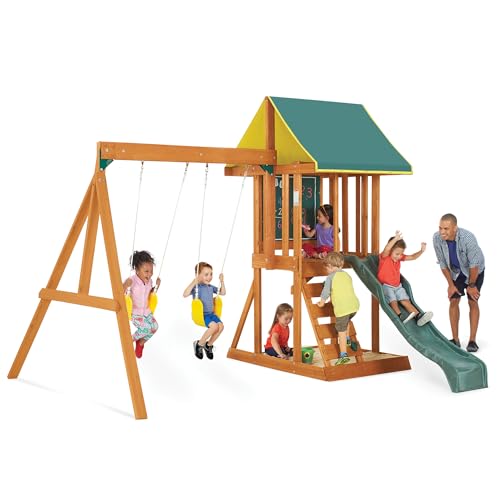
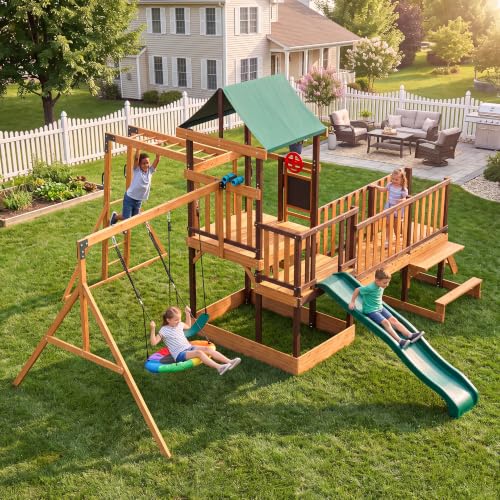
These premium structures often include a climbing tower, a slide, and sometimes a lower play deck. They offer the most visual appeal and blend naturally into garden landscapes. A swing set with tree house and slide adds an imaginative element that sparks storytelling and creative play. Wooden sets are typically top-tier in terms of durability and long-term investment value, provided they use high-grade timber and weather-resistant coating.
Metal Swing Sets
Steel-framed swing sets are known for their stability and resistance to rot and insects. They often sit in the essential-tier to mid-range categories and are a solid choice for families who prioritize low maintenance. Look for powder-coated finishes and reinforced joints for the best longevity.
Multi-Feature Play Centers
For families who want maximum variety, a swing set with slide and monkey bars combines swinging, sliding, and upper-body strength challenges in one footprint. These play centers are feature-rich for their class and keep children engaged across a broader age range.
Age-Appropriate Swing Sets: Matching the Set to Your Child
Age is one of the most important factors in choosing a swing set. A set designed for a toddler may not safely accommodate a school-age child, and vice versa. Here is a breakdown to guide your decision:
For Toddlers and Preschoolers (Ages 2–5)
Young children need lower swing heights, bucket-style seats for secure support, and gentler slopes on slides. A swing set for 2–5 year olds typically features a high back and leg openings on the swing seats to prevent slipping. Supervision is essential, but these sets are designed with safety-first geometry for small bodies.
For School-Age Kids (Ages 6–10)
At this stage, children can handle standard belt swings, glide rides, and more challenging climbing elements. A swing set for ages 6 and up often includes taller frames, monkey bars, and climbing walls. If you want a structure that grows with your family, consider a swing set with slide and climbing wall that offers graduated challenges.
For Older Children (Ages 8–12)
Older kids still enjoy swinging, but they also seek more dynamic play like teeter-totters, trapeze bars, and larger slides. A swing set for 8–10 year olds typically features heavier-duty hardware and taller clearance. For families with multiple age groups, a swing set with slide and teeter-totter provides entertainment for a wider range of abilities.
If you are also considering ride-on vehicles for your children, our guide to ride-on toys for 6–8 year olds can help you round out an active backyard.
Materials and Durability: What to Look For
The material of your swing set determines its longevity, maintenance requirements, and aesthetic appeal. Here is a comparison of the most common options:
| Material | Tier | Best For | Key Qualities |
|---|---|---|---|
| Wood (Cedar/Pine) | Mid-range to premium | Families wanting a natural look and customizable play centers | Durable construction with proper sealing; heavy-duty options available |
| Steel/Metal | Essential to mid-range | Low-maintenance yards and families prioritizing stability | Rust-proof finish, reinforced joints, high-grade steel frames |
| Composite/High-Density Polyethylene | Premium to luxury | Families seeking long-term investment with minimal upkeep | Weather-resistant coating, no splintering, fade-resistant colors |
Regardless of material, check for reinforced connections at all stress points. A solid build with high-grade hardware is the best indicator of a set that will hold up through years of active play. For a truly robust option, a commercial-grade swing set is designed for heavy use and may be a wise choice for large families or community spaces.
Safety Features That Matter
Safety should never be an afterthought. When evaluating swing sets, prioritize the following:
- Sturdy Anchoring: Ground anchors or concrete footings prevent tipping. Most quality sets include anchoring hardware.
- Age-Appropriate Seats: Bucket seats for toddlers, belt swings for older children, and glider attachments for shared swinging.
- Smooth Edges and Hardware: Look for capped bolts, rounded corners, and no exposed sharp edges on slides or climbing elements.
- Stable Footing: Wide bases and A-frame designs distribute weight evenly. Avoid sets with narrow, unstable legs.
- Safe Fall Zones: Ensure adequate clearance around the set — at least 6 feet on all sides — and install shock-absorbing surfacing such as wood chips or rubber mulch beneath the structure.
Space Planning: Making the Most of Your Backyard
Before buying, measure your available outdoor space and account for a safe play perimeter. A swing and slide set for a small backyard is specifically designed for tight spaces without sacrificing fun. For patios or hardscaped areas, a swing set for patio use may be a better fit if it features a compact frame and protective footing.
If you want to add a climbing challenge that fits within a modest footprint, consider a swing set with slide and rock wall. These designs pack multiple activities into a single structure, maximizing play value per square foot.
Features That Enhance Play Value
Beyond the basic swing and slide, many playsets include add-ons that extend engagement and development:
- Monkey Bars: Build upper-body strength and coordination. A swing set with monkey bars is a classic choice for school-age children.
- Tube Slides: Offer a faster, more enclosed sliding experience. A swing set with tube slide and monkey bars combines thrill with physical challenge.
- Climbing Walls: Add vertical exploration and problem-solving. Look for textured holds and proper fall surfacing underneath.
- Play Decks and Towers: Provide a shaded retreat and a platform for imaginative play, especially when paired with a canopy or tree-house style roof.
For families with older children, our guide to swing sets for 10–12 year olds covers designs that still offer engaging physical challenges without feeling too juvenile.
Quick Buying Checklist
Use this checklist to streamline your decision:
- Measure your yard and confirm the safe fall zone dimensions.
- Identify the primary age range of your children and choose accordingly.
- Decide on material: wood for aesthetics, metal for low maintenance, composite for long-term durability.
- Check for anchoring hardware, rounded edges, and age-appropriate seats.
- Consider future growth: a set with modular features can adapt as children age.
- Review assembly requirements and warranty terms.
- Plan for ground surfacing before installation day.
For a broader look at outdoor play equipment that pairs well with swing sets, explore our top outdoor toys collection. And if you are outfitting a playroom as well, our swing sets for kids overview covers the fundamentals of choosing a first set.
Frequently Asked Questions
How much space do I need for a swing set?
As a rule of thumb, allow at least 6 feet of clearance on all sides of the structure, plus additional space in front of and behind the swings for safe motion. For a standard A-frame set, a 20 x 20 foot area is a comfortable minimum. Compact models for small backyards are available and typically need less.
What age is appropriate for a swing set?
Children as young as 2 can use bucket-seat swings with supervision. Most standard swing sets are designed for ages 3–10, while heavy-duty wooden playsets may accommodate older children up to age 12. Always follow the manufacturer's age recommendations and weight limits.
Wood or metal: which is better?
Wood offers a natural look, is customizable, and can be stained or sealed for longevity. Metal is lower maintenance, resistant to rot and insects, and often more budget-friendly within its class. Both can be durable — prioritize solid construction, reinforced joints, and weather-resistant finishes regardless of material.
How do I anchor a swing set safely?
Most quality sets include ground anchors that stake into the soil. For added stability, concrete footings can be used, especially for larger wooden structures. Always follow the manufacturer's anchoring instructions and check stability periodically, particularly after heavy rain or wind.
What surfacing is best under a swing set?
Shock-absorbing surfaces such as wood chips, rubber mulch, or engineered wood fiber are recommended. Grass and dirt do not provide adequate impact protection. Aim for a surfacing depth of at least 9 inches for most residential sets, and maintain the material regularly.