Swing Sets for 2-5 Year Olds: The Complete Guide to Safe Backyard Fun
Everything you need to choose a safe, age-appropriate swing set for toddlers and preschoolers — from bucket seats and frame stability to backyard placement and long-term durability.
Explore the Buying Guide🌳 Why a swing set for ages 2-5 deserves careful thought: This is the stage when children transition from baby swings to independent swinging — and the equipment they use during these years shapes their confidence, coordination, and love of outdoor play. A well-chosen swing set supports healthy physical development while keeping safety front and center. In this guide, we break down the features that matter most, the safety standards to look for, and how to match a set to your child's developmental stage.
Why Swing Sets Are a Smart Investment for Early Childhood
Swings are more than just backyard entertainment. For children aged 2 to 5, swinging delivers a steady dose of vestibular stimulation — the movement that helps the brain process balance, spatial awareness, and coordination. Pediatric occupational therapists frequently recommend swinging as part of sensory integration therapy because the gentle, repetitive motion calms the nervous system while building core strength.
Beyond the physical benefits, a swing set becomes a social hub. Toddlers learn to take turns, wait for their siblings, and negotiate shared space. Preschoolers invent games, sing songs, and practice counting by timing their swings. The backyard becomes a classroom, and the swing set is the centerpiece. If you are still exploring broader outdoor options for this age group, our guide to top outdoor toys for 2-year-olds and top outdoor toys for 3-year-olds offers useful context for building a well-rounded play space.
Key Features to Look for in a Swing Set for Ages 2-5
🪣 Full-Bucket Seats
The gold standard for ages 2-3. A full-bucket seat cradles the child's entire torso, providing head and neck support during the swinging motion. Look for high-backed buckets with leg holes that are not too large.
🔗 Chain or Rope Covers
Exposed chains can pinch small fingers. Choose swings with plastic-coated chains or thick rope covers that protect little hands while remaining easy to grip.
📏 Low Platform Height
For ages 2-5, the swing beam should sit low enough that a child can be lifted in easily and can touch the ground when the swing is at rest. This builds confidence and reduces fear.
⚓ Ground Anchoring
Every swing set for this age group must be anchored to the ground — either with stakes, concrete footings, or weighted bases. A tipping frame is the single biggest hazard for young children.
🧱 Sturdy Frame Construction
Look for thick legs, cross-bracing, and a wide footprint. Wooden sets with cedar or redwood offer solid build and natural weather resistance; metal sets with powder-coated steel resist rust.
🛡️ Rounded Edges & No Exposed Hardware
Every bolt, screw, and sharp corner is a potential injury point. Check that hardware is recessed or capped, and that all plastic components are smooth with no molding seams.
Understanding Safety Standards and Age Labels
Before you browse any swing set, understand that age labels on packaging are not arbitrary. They are based on ASTM International standards (F1148 for home playground equipment) and reflect developmental milestones — not just size. A set labeled "ages 2-5" has been evaluated for the strength, coordination, and behavior patterns typical of that range.
Never push a child onto equipment labeled for older ages. A 4-year-old may physically fit on a swing designed for ages 6 and up, but the frame height, swing clearance, and fall height may not be appropriate. For a deeper look at safety considerations across different age brackets, see our guide to swing sets for kids and our breakdown of swing sets for ages 6 and up.
Critical Safety Checklist for Ages 2-5
- Full-bucket seats for children under 4, with a high back and a safety strap if available.
- Ground anchors installed per the manufacturer's instructions — never skip this step.
- At least 6 feet of clearance on all sides, with no trees, fences, or walls within the swing path.
- Soft landing surface beneath the set — rubber mulch, wood chips, or a poured rubber mat. Grass alone does not provide adequate fall protection.
- No more than two swings on a compact toddler set to prevent crowding and collisions.
- Supervision at all times for children under 5, even on "independent" play equipment.
- Regular inspection of chains, bolts, and frame stability — at least monthly during active use.
Comparing Tier Levels: Entry-Level vs. Mid-Range vs. Premium Swing Sets
Swing sets for this age group span a wide range of construction quality and feature sets. To help you orient yourself without relying on fluctuating figures, here is a tier-based comparison based on build quality, material grade, and feature depth.
| Tier | Typical Construction | Best For | Key Trade-Offs |
|---|---|---|---|
| Entry-Level | Lightweight metal frame or thinner wood; basic bucket seat; minimal accessories | Families with limited space or a single toddler who will outgrow the set within 2-3 years | Lighter build may require more frequent anchoring checks; fewer add-on features |
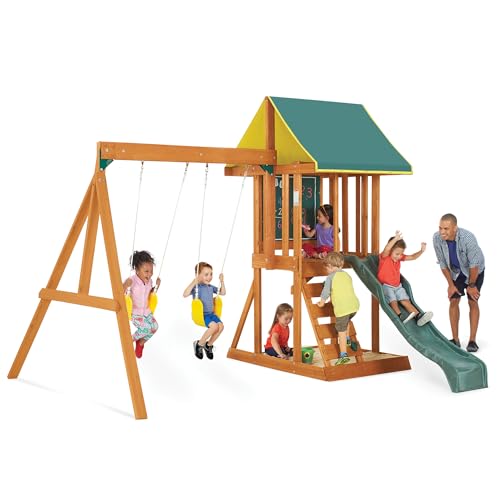
| Mid-Range | Solid wood or powder-coated steel frame; high-backed bucket seat plus a belt swing; small slide or glider | Families with two children in the 2-5 range, or those who want a set that grows with the child for 4-6 years | Assembly is more involved; footprint is larger, requiring more backyard space |
| Premium | Heavy-duty cedar or redwood with reinforced joints; multiple swing types; integrated climbing wall, slide, or play deck | Families planning a long-term backyard investment with multiple children across age ranges | Higher initial outlay; professional installation often recommended; needs a substantial flat area |
If you are planning a more elaborate setup — perhaps with a slide, climbing wall, or monkey bars — our guides to swing sets with slide and climbing wall and swing sets with monkey bars explore those configurations in detail. For smaller yards, the swing and slide set for small backyard guide is especially relevant.
Matching the Swing Set to Your Child's Developmental Stage
Ages 2-3: The Bucket Seat Years
At this stage, the child's center of gravity is high and their grip strength is still developing. A full-bucket seat is non-negotiable. The swing set should be low to the ground, with a frame that does not sway or wobble when the child shifts weight. A gentle push from an adult is all the motion needed — the goal is comfort and familiarity, not height. For more ideas on toys that support this developmental window, see our roundup of top toys for two-year-olds and top 10 toys for 2-year-olds.
Ages 3-4: Transitioning to Independence
Around age 3, many children develop the core strength to sit upright in a belt swing — but only with supervision and only if the swing is low enough for their feet to touch the ground. A convertible swing set that includes both a bucket seat and a belt swing is ideal during this transition. Keep the bucket seat available for rest periods or for younger siblings. Our guide to top toys for three-year-olds offers additional context on this developmental stage.
Ages 4-5: Building Confidence and Skills
By age 4-5, most children can pump their legs independently, though they still need reminders to hold the chains with both hands. This is the age when a swing set with a small slide or a glider becomes a full playground — children move between activities, building stamina and social skills. If you are considering a set with additional play features, the swing set with slide and rock wall and swing set with slide and teeter-totter guides are worth reviewing.
Wooden vs. Metal Swing Sets: Which Is Right for Your Backyard?
Both materials have strong advocates, and the right choice depends on your climate, space, and long-term plans.
Wooden swing sets (cedar, redwood, or treated pine) offer a natural aesthetic that blends into the landscape. They tend to be heavier and more stable, which is a significant advantage for active toddlers. Cedar and redwood are naturally resistant to rot and insects, making them a long-term investment in humid climates. The trade-off is that wooden sets require periodic sealing or staining to maintain their appearance and structural integrity.
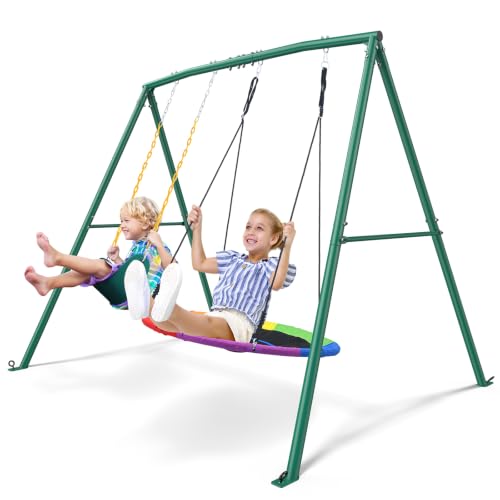
Metal swing sets (powder-coated steel or aluminum) are lighter, easier to relocate, and generally require less maintenance. A high-grade steel frame with a rust-proof finish can last many years with minimal care. However, lighter metal sets can be more prone to tipping if not properly anchored, so ground stakes or concrete footings are essential. For a deeper comparison of frame styles across age groups, see our guide to swing sets.
💡 Pro Tip: Whatever material you choose, set the swing beam height so that the bottom of the bucket seat sits roughly 24 inches above the ground when at rest. This makes it easy for an adult to lift a toddler in and out without straining, and it allows the child to feel the ground beneath their feet — a key confidence booster for first-time swingers.
Backyard Placement and Setup: Getting It Right the First Time
The location of your swing set matters as much as the set itself. Choose a spot that is:
- Flat and well-drained — a slope greater than 2-3 degrees can cause the frame to shift over time.
- Visible from the house — so you can supervise from a window or doorway while preparing meals.
- Free from overhead hazards — check for power lines, low tree branches, and fence posts.
- Shaded during peak sun — a partially shaded spot reduces heat buildup on metal and plastic surfaces.
- Clear of the swing path — at least 6 feet in front and behind the swing beam, and twice the beam height for older children who swing higher.
If your backyard is compact, a dedicated swing set for patio or a swing and slide set for small backyard may be the best fit. These compact configurations are designed for tight spaces without compromising on the core safety features.
Long-Term Care and Maintenance
A swing set is an investment in your child's outdoor play, and a few simple maintenance habits will keep it safe and functional for years:
- Inspect monthly during active seasons — check bolts, chains, swing seats, and frame joints.
- Tighten hardware as needed — vibrations from swinging can loosen bolts over time.
- Replace worn seats — cracked or faded plastic can develop sharp edges.
- Reapply sealant on wooden sets every 1-2 years, depending on your climate.
- Check ground anchors after heavy rain or freeze-thaw cycles.
- Store removable accessories (swings, gliders) during extreme weather to extend their lifespan.
For a broader look at how swing sets fit into a complete outdoor play strategy, our guide to top outdoor toys and swing sets for 8-10 year-olds can help you plan for the years ahead.
Frequently Asked Questions
For a 2-year-old, prioritize a swing set with full-bucket seats, a sturdy frame anchored securely to the ground, rounded edges with no exposed bolts, and a low platform height. The structure should be stable with no tipping risk, and all materials should be non-toxic and weather-resistant.
Most 3-year-olds should still use a full-bucket seat for proper head and neck support. Transition to a belt swing only when the child can sit independently, hold the chains firmly, and has sufficient core strength — typically around age 4 to 5, depending on the child's development.
A good rule of thumb is to allow at least 6 feet of clearance on all sides of the swing set, plus twice the height of the swing beam in front and behind for swinging clearance. For a compact toddler set, a backyard area of roughly 10 x 10 feet is often sufficient.
Both can be excellent. Wooden sets offer a natural look and tend to be sturdy and stable, while metal sets are often lighter and easier to relocate. For ages 2-5, look for a set with a wide base, ground anchors, and smooth, splinter-free surfaces regardless of material.
Inspect the swing set at the start of each season and then monthly during active use. Check for loose bolts, worn chains or ropes, cracked plastic, rust, and stability of ground anchors. Tighten or replace any worn components immediately before allowing children to play.