
iPad Learning Games for 3 Year Olds: A Complete Parent's Guide
Discover how to choose safe, engaging, and developmentally appropriate iPad learning games that build early literacy, numeracy, and problem-solving skills for your three-year-old.
🧠 Why This Guide Matters: A three-year-old's brain is developing at an extraordinary pace. The right iPad learning games can reinforce colors, shapes, letters, and numbers while nurturing curiosity and cause-and-effect thinking. But with thousands of apps available, parents need a reliable framework to separate genuinely educational titles from distracting ones. This guide walks you through what to look for, how much screen time is healthy, and which categories of games deliver real developmental value for toddlers.
The Science Behind Early Digital Learning
Research in early childhood development shows that three-year-olds learn best through interactive, multisensory experiences. Well-designed iPad learning games mirror this by combining touch, sound, and visual feedback in ways that reinforce concepts like object permanence, sequencing, and categorization. However, passive video watching does not deliver the same benefits. The key distinction is active engagement — games that require your child to tap, drag, match, or solve a problem keep their brain actively processing rather than passively receiving information.
When selecting titles for your three-year-old, prioritize apps built around the skills that matter most at this age: fine motor control, early phonemic awareness, counting from one to ten, shape and color recognition, and simple pattern completion. Many parents exploring hand-eye coordination toys for 3 year olds discover that a balanced mix of physical and digital play produces the strongest developmental outcomes.
Key Benefits of Quality iPad Learning Games
🎨 Color & Shape Recognition
Interactive matching games reinforce visual discrimination skills that form the foundation of early reading and math. Toddlers learn to sort, compare, and categorize through playful repetition.
🔤 Early Letter & Sound Exposure
Phonics-focused apps introduce letter sounds through songs, tracing activities, and animated characters, building pre-reading awareness without pressure or frustration.
🔢 Counting & Number Sense
Number games help three-year-olds connect spoken numbers to quantities, an essential step toward mathematical thinking. Look for counting activities paired with visual objects.
🧩 Problem-Solving & Logic
Simple puzzles and cause-and-effect games teach children to predict outcomes, test ideas, and persist through challenges — skills that transfer to offline play and beyond.
✋ Fine Motor Development
Tapping, dragging, and tracing on a touchscreen strengthens the small muscles in fingers and hands, preparing children for handwriting and other precision tasks later on.
🗣️ Language & Vocabulary Growth
Narrated games with clear, expressive speech expose toddlers to new words in context. Co-playing with a parent amplifies this benefit by encouraging conversation.
How to Evaluate iPad Learning Games: A Tier-Based Framework
Not all educational apps are created equal. Use this tier framework to assess quality and match games to your child's needs and your family's preferences. The tiers reflect relative positioning within the category, not any specific figures.
| Tier | Characteristics | Best For |
|---|---|---|
| Essential Tier | Simple interface, minimal content, basic skill reinforcement | First introduction to digital learning |
| Balanced Tier | Multi-skill coverage, adaptive difficulty, parent dashboard | Regular daily or weekly learning sessions |
| Top-Tier | Rich content library, progress tracking, offline access, no ads | Families seeking comprehensive curriculum support |
| Premium Tier | Research-backed pedagogy, personalized learning paths, expert design | Parents wanting the most rigorous early-learning tools |
When comparing options, remember that a balanced-tier game often delivers more long-term value than an essential-tier title because it grows with your child. Meanwhile, premium-tier apps sometimes include features your three-year-old may not yet need. Match the tier to your child's attention span and your family's learning goals. For families also considering broader digital tools, our kids tablet comparison offers useful context on hardware choices.
Essential Checklist Before Downloading Any Game
- No third-party ads: Ads interrupt learning and may lead to unintended taps. Choose ad-free apps or those with a one-time unlock.
- No in-app purchase prompts: Three-year-olds cannot distinguish between gameplay and purchase screens. Avoid apps that gate content behind purchase nudges unless you enable parental controls.
- Age-appropriate content rating: Look for apps explicitly rated for ages 3–5. Avoid anything rated for older children even if the theme seems simple.
- Large, simple touch targets: Buttons should be big enough for small fingers. Complex gestures like multi-finger swipes are frustrating for toddlers.
- No reading required to play: Three-year-olds are pre-readers. Games should rely on icons, voice instructions, and visual cues.
- Offline mode available: Useful for car rides and travel, and it reduces exposure to unexpected online content.
- Parental dashboard or progress tracking: Lets you see what your child is learning and identify areas needing reinforcement.
- Positive reinforcement design: Games should celebrate effort and progress without overstimulating or encouraging endless play.
Screen Time Guidelines for Three-Year-Olds
Leading pediatric organizations recommend that children aged two to five have no more than one hour per day of high-quality screen time, and that parents co-view or co-play whenever possible. For three-year-olds specifically, shorter sessions of ten to fifteen minutes are often more effective than a single long block. Break up screen time with physical activity, outdoor play, and hands-on exploration. Families who invest in interactive toys for 3–4 year olds often find that mixing digital and tactile play keeps toddlers engaged and balanced.
Consider designating screen time as a shared activity. Sitting with your child while they play an iPad learning game turns a solitary activity into a language-rich interaction. Ask questions like "What color is that?" or "How many apples do you see?" to extend the learning beyond the screen. For children who enjoy structured physical challenges alongside digital learning, gross motor toys provide an excellent counterbalance.
Types of Learning Games That Work Best for Three-Year-Olds
Cause-and-effect games are ideal entry points. When a child taps an object and it reacts with sound or animation, they learn that their actions have consequences — a foundational cognitive concept. Matching and sorting games build visual discrimination and categorization skills. Letter tracing and phonics apps introduce early literacy through guided finger movements and sound associations. Counting and number games connect numerals to quantities in a playful way. Simple puzzle apps develop spatial reasoning and persistence. Creative play apps — drawing, music-making, or virtual sticker books — encourage open-ended expression and imagination.
Avoid apps with excessive animation, constant rewards, or chaotic soundscapes. These can overstimulate young children and reduce attention span over time. The best learning games are calm, focused, and paced to let your child think and respond. If your child also enjoys imaginative offline play, imaginative play ideas can complement digital learning beautifully.
Balancing Digital and Physical Play
iPad learning games are one tool in a broader developmental toolkit. Three-year-olds thrive when they have varied experiences: building with blocks, running outdoors, painting, singing, and engaging in pretend play. Digital games should supplement, not replace, these activities. If your child shows strong interest in construction and spatial play, consider hands-on toys for 4 year olds as a bridge to more advanced building concepts. Similarly, children who enjoy active challenges may benefit from indoor climbing toys for 3 year olds to develop strength and coordination alongside cognitive skills.
Frequently Asked Questions
How much screen time is appropriate for a 3 year old?
Most pediatric guidelines suggest limiting screen time for 3 year olds to about one hour per day of high-quality educational content, ideally co-viewed with a parent to reinforce learning and encourage conversation.
What makes an iPad learning game suitable for a 3 year old?
A suitable game features simple touch controls, large buttons, no reading requirement, no external ads, no in-app purchase prompts, and content focused on colors, shapes, numbers, letters, and cause-and-effect exploration.
Do iPad learning games actually help toddlers learn?
When chosen well and balanced with offline play, high-quality educational apps can support early literacy, numeracy, and problem-solving skills. The key is active engagement rather than passive consumption.
Should I let my 3 year old use an iPad alone?
Parental co-use is strongly recommended for 3 year olds. Sitting alongside your child helps them understand content, encourages language development, and lets you monitor app quality and safety.
Are there iPad games that grow with my child?
Yes. Many balanced-tier and top-tier apps include adaptive difficulty that adjusts as your child masters skills. These are often better long-term investments than single-skill essential-tier games, because they remain relevant as your child approaches age four and five.
Ready to Find the Perfect Learning Games?
Explore our hand-picked recommendations below to start your child's educational journey today.
Recommended iPad Learning Games & Accessories for 3 Year Olds
⚠️ AFFILIATE DISCLOSURE: This website contains affiliate links. As an Amazon Associate, we earn from qualifying purchases. If you make a purchase through these links, we may receive a small commission at no additional cost to you. Read our full affiliate policy.

Learning Tablet for Toddlers 1-3 - Educational ABC Toy to Learn Alphabet, Number, Music & Words - Early Development Electronic Learning & Activity Game, Suitable for 1 2 3 Year Old Boys & Girls
Check price on Amazon
QuTZ Talking Flash Cards, Phonics Flash Cards, Learn to Read with 166 Pages, 29+ Themes, 800+ Words & Fun Facts, 700+ Interactive Games, Toddler Learning Toys for 3-6 Year Old
Check price on Amazon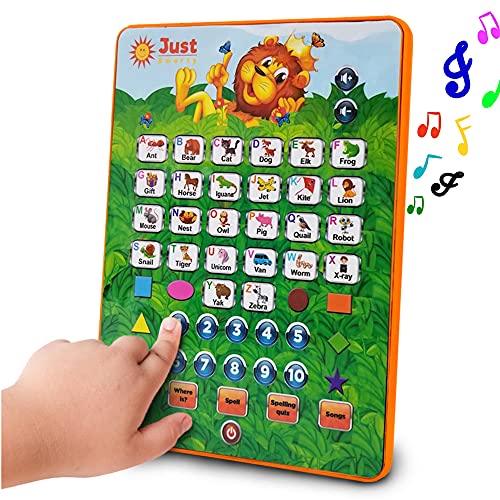
Just Smarty Alphabet Tablet for Kids Age 3-5 Year Old Boys & Girls
Check price on Amazon
WEOLULI Kids Smart Phone Toy for Toddler Girls Boys Ages 3-10
Check price on Amazon
Qiaojoy Kids Learning Tablet Educational Learning Pad for Toddlers 2-5
Check price on Amazon
SYNARRY Unicorn Mermaid Princess Magnetic Puzzles for Kids 3-5, Travel Toys
Check price on Amazon
Qiaojoy Kids Learning Tablet -Educational Tablet Toy to Interactive LearnColors, Alphabets,Number,Foods,Animals,Weather,Screen-Free Learning Toys for Toddlers 2-6 Years Old,Gifts for Boys Girl
Check price on Amazon