
Educational Toys for Three Year Olds: The Complete Guide
Three is a magical age of curiosity, language explosion, and boundless imagination. Discover the educational toys that nurture your child's rapidly developing brain and set the foundation for a lifelong love of learning.
Explore Top Toy Types🧠 Why Three Year Olds Are Ready to Learn: At age three, children experience a remarkable period of brain development. Their vocabulary expands from a few hundred words to over a thousand, their fine motor skills allow them to manipulate smaller objects, and their imagination takes flight through pretend play. The right educational toys at this stage do more than entertain—they build neural pathways that support future academic success, social competence, and emotional regulation.
This guide helps parents, grandparents, and caregivers cut through the overwhelming toy market to find genuinely educational options. We explain what makes a toy educational at this age, which toy types deliver the strongest developmental benefits, how to evaluate safety, and how to build a balanced toy collection that grows with your child.
Why Educational Toys Matter at Age Three
The preschool years represent a critical window for cognitive, language, motor, and social-emotional development. Unlike passive entertainment, educational toys are designed to engage children actively—requiring them to think, problem-solve, create, communicate, and persist through challenges. These experiences build the executive function skills that predict later success in school and life.
Research in early childhood development consistently shows that guided play with educational toys supports school readiness. When three year olds engage with puzzles, building sets, and pretend play props, they practice the exact skills that kindergarten teachers look for: the ability to follow multi-step directions, sustain attention, cooperate with peers, express ideas clearly, and regulate frustration when something doesn't work the first time.
🧩 Cognitive Development
Puzzles, matching games, and building sets strengthen problem-solving abilities, spatial reasoning, memory, and the capacity to plan ahead. These toys teach children to break complex tasks into manageable steps and persist until they reach a solution.
🗣️ Language & Literacy
Storytelling toys, alphabet games, and pretend play sets with props expand vocabulary, encourage narrative thinking, and build the phonological awareness that precedes reading. Three year olds learn new words most effectively through hands-on play and conversation.
✋ Fine Motor Skills
Art supplies, lacing cards, pegboards, and manipulatives develop the small muscle control needed for writing, buttoning, and self-care. At age three, children transition from whole-hand grasping to more precise pincer grips—educational toys make this practice enjoyable.
🤝 Social & Emotional Growth
Cooperative games, pretend play with friends, and turn-taking activities teach sharing, negotiation, empathy, and emotional regulation. These toys create natural opportunities for children to practice the social skills they'll rely on throughout life.
Top Educational Toy Types for Three Year Olds
Not all toys marketed as "educational" deliver genuine developmental value. The strongest choices for three year olds share key characteristics: they're open-ended enough to support multiple types of play, they match the child's current abilities while offering a small stretch, and they engage multiple senses simultaneously. The following toy categories consistently earn high marks from early childhood educators and child development researchers.
1. Building Blocks and Construction Sets Essential Tier
Blocks are the quintessential open-ended educational toy. Whether wooden cubes, interlocking plastic bricks, magnetic tiles, or foam construction pieces, building toys support spatial reasoning, mathematical thinking (size, symmetry, balance), and creative problem-solving. Three year olds progress from simple stacking and knocking down to creating enclosures, bridges, and representational structures.
For this age group, consider larger blocks that are easy to grip, magnetic tiles that snap together satisfyingly, and sets with wheels or character pieces that extend play into pretend scenarios. You can explore more options in our guide to educational toys for 2-3 year olds for building concepts that bridge the toddler-to-preschool transition.
2. Puzzles and Matching Games Balanced Tier
Puzzles directly train visual-spatial reasoning, attention to detail, and persistence. At age three, children typically progress from chunky wooden puzzles with individual piece outlines to 12-24 piece framed puzzles. The satisfying "click" of a correct placement provides immediate feedback and motivation to continue.
Look for puzzles with varying themes—animals, vehicles, faces, or the alphabet—to build vocabulary alongside problem-solving skills. Matching games (memory pairs, lotto boards, attribute-matching sets) add social play opportunities and reinforce categorization skills. Our guide to educational toys for 3-4 year olds covers puzzle progression in more detail.
3. Pretend Play Sets and Props Essential Tier
Pretend play is the highest form of learning for three year olds. When children engage in imaginative scenarios—cooking in a play kitchen, caring for dolls, running a pretend store—they practice language, narrative thinking, social roles, and emotional regulation simultaneously. Props like play food, doctor kits, tool sets, and dress-up costumes provide scaffolding for increasingly complex play scenarios.
The key is choosing flexible props that serve multiple scenarios rather than single-purpose toys that quickly lose their novelty. A set of wooden play food, a few simple costumes, and a doctor's kit will sustain interest far longer than a battery-operated toy that performs only one function. For related ideas, see our guide to dress-up gifts for 3 year olds.
4. Art and Craft Materials Balanced Tier
Art supplies develop fine motor control, creative expression, and the ability to plan and execute a project. For three year olds, prioritize large crayons and washable markers, chunky paintbrushes, finger paints, play dough, and safety scissors designed for small hands. Collage materials, stickers, and simple weaving or lacing activities also build dexterity.
The process matters far more than the product at this age. Children learn through squeezing, smearing, tearing, and manipulating materials—the finished artwork is secondary. Keep a dedicated art station stocked with accessible supplies to encourage spontaneous creativity. See our broader coverage in educational toys for 3-4 year olds for additional artistic development ideas.
5. Early STEM and Montessori-Inspired Toys Premium Tier
STEM toys for three year olds introduce scientific thinking, mathematical concepts, and engineering problem-solving in age-appropriate ways. Magnetic tiles, simple gears and cogs sets, balance scales, pattern blocks, and sorting trays with natural materials all build foundational STEM thinking. Montessori-inspired toys—often made from wood with natural finishes—emphasize independent exploration, self-correction, and real-world skills like pouring, transferring, and fastening.
When evaluating STEM toys for this age group, look for options that reward experimentation rather than requiring a single correct answer. Open-ended materials like magnetic tiles or pattern blocks sustain interest far longer than toys that perform only one pre-programmed function. Our educational toys for 3-4 year olds guide includes more STEM recommendations.
6. Language and Literacy Toys Balanced Tier
Three year olds are in the midst of a language explosion. Toys that support this—alphabet puzzles, rhyming games, storytelling cards, interactive books, and simple word-building sets—make literacy learning playful. Phonological awareness activities like rhyming and syllable clapping are particularly valuable at this age. Our guides to educational toys for 2-3 year olds and educational games for 3-5 year olds explore language-focused options in depth.
Toy Type Comparison by Developmental Focus
The table below summarizes how each major toy category supports different areas of development for three year olds. Use it to identify gaps in your child's toy collection and ensure a balanced mix that addresses all developmental domains.
| Toy Category | Primary Developmental Benefit | Best For | Tier |
|---|---|---|---|
| Building Blocks | Cognitive & spatial reasoning | Problem-solvers who love to create | Essential Tier |
| Puzzles & Matching | Visual-spatial & persistence | Focused children who enjoy solving | Balanced Tier |
| Pretend Play Sets | Language & social-emotional | Imaginative, social children | Essential Tier |
| Art Materials | Fine motor & creative expression | Hands-on creative learners | Balanced Tier |
| STEM & Montessori | Scientific thinking & independence | Curious explorers and tinkerers | Premium Tier |
| Language & Literacy | Vocabulary & pre-reading skills | Talkative, book-loving children | Balanced Tier |
How to Choose Educational Toys for Your Three Year Old
With thousands of toys competing for attention, a systematic approach helps you make informed choices. Consider these factors when evaluating any potential purchase:
Match the Toy to Your Child's Interests and Abilities
Observe what your child naturally gravitates toward. A child who loves to build will thrive with construction sets; a child who narrates elaborate stories will benefit most from pretend play props and storytelling toys. Choose toys that sit just slightly above your child's current skill level—challenging enough to promote growth, but not so difficult that frustration overwhelms motivation.
Prioritize Open-Ended Play Value
The most educational toys can be used in multiple ways. A set of wooden blocks can become a tower, a bridge, a castle, a road, or a pattern. A play kitchen supports cooking scenarios, restaurant play, grocery store games, and family role-play. Open-ended toys sustain interest for years rather than weeks, making them a worthwhile long-term investment for your family.
Consider the Play Environment
Think about where and how your child will use the toy. Will it work in your home's play space? Is it portable enough for travel or outdoor play? Does it require adult supervision? A toy that fits your family's daily routines will see far more use than one that's awkward to set up or store.
Evaluate Safety and Durability
Three year olds are active, curious, and not always gentle with their belongings. Choose toys with durable construction, non-toxic finishes, and no small detachable parts that could pose a choking hazard. The sections below cover safety considerations in detail.
Safety Considerations for Three Year Olds
While three year olds have largely outgrown the mouthing behavior of infancy, they remain vulnerable to choking, injury from sharp edges or projectiles, and exposure to toxic materials. Follow these safety guidelines when selecting educational toys:
- Age labeling: Choose toys explicitly labeled for ages 3 and up. Toys for younger children may contain small parts that pose choking hazards.
- Small parts check: Avoid toys with parts smaller than a toilet paper tube. Small marbles, beads, or toy components can be swallowed by curious three year olds.
- Non-toxic materials: Verify that paints, finishes, and plastics are non-toxic and free from lead, phthalates, and BPA. Look for toys that meet ASTM F963 or EN71 safety standards.
- No sharp edges or points: Inspect toys for rough edges, exposed screws, or sharp corners. Wooden toys should be sanded smooth with rounded edges.
- Sturdy construction: Toys should withstand dropping, throwing, and pulling without breaking into dangerous pieces. Avoid flimsy plastic that cracks or splinters.
- Avoid long cords and strings: Strings longer than 12 inches pose strangulation hazards. Skip toys with long pull cords or lanyards.
- Supervise active play: Riding toys, climbing structures, and water play require close adult supervision. Ensure surfaces are safe and equipment is stable.
- Check for recalls: Periodically verify that your toys haven't been recalled due to safety defects. Register products when possible to receive recall notifications.
Building a Balanced Educational Toy Collection
A thoughtfully curated toy collection beats a room overflowing with random items. Aim for a manageable number of high-quality toys that cover all developmental domains and can be rotated to maintain novelty. A practical approach is the "rotation system": keep a subset of toys accessible while storing the rest, then swap them every few weeks. This strategy keeps children engaged without overwhelming them—or your living room.
For three year olds, a balanced core collection might include:
- Construction: A set of wooden blocks, a set of magnetic tiles, and a medium-sized interlocking brick set.
- Puzzles: Three to five puzzles at varying difficulty levels (12-24 pieces).
- Pretend play: A play kitchen or dollhouse, plus a collection of flexible props (play food, doctor kit, dress-up items).
- Art supplies: Washable markers, crayons, paper, play dough, and safety scissors stored in an accessible art station.
- Language & literacy: A rotating selection of picture books, alphabet puzzles, and rhyming games.
- STEM & discovery: A simple sorting set, pattern blocks, or magnetic exploration kit.
This core collection supports all developmental domains and can be expanded based on your child's emerging interests. For additional ideas tailored to slightly older children, see our guides to educational toys for 3-4 year olds and educational toys for 4-5 year olds. If you're specifically looking for group play options, our educational games for 3-5 year olds guide is also helpful.
Frequently Asked Questions
Ready to Find the Perfect Educational Toys?
Explore our hand-picked selection of top-rated educational toys that support your three year old's development through play. Each product is chosen for quality, safety, and genuine learning value.
View Recommended ToysBest Educational Toys for Three Year Olds
⚠️ AFFILIATE DISCLOSURE: This website contains affiliate links. As an Amazon Associate, we earn from qualifying purchases. If you make a purchase through these links, we may receive a small commission at no additional cost to you. Read our full affiliate policy.

Airbition Talking Flash Cards for Toddlers Ages 1‑4,224 Words English Blue | Montessori Language Learning Toys with 224 Words, Pocket Speech Therapy Toys, Sensory Learning Kit, Educational Toys for Kids
Check price on Amazon
LeapFrog Mr Pencil's Scribble Write and Read, Green
Check price on Amazon
Dinosaur Toys,Magnetic Color and Number Maze, Montessori Toys for 3 4 5 Year Old,Learning Educational Sensory Toys for Kids Boys Girls,Christmas Stocking Stuffers for Kids
Check price on Amazon
LeapFrog Prep for Preschool Activity Book
Check price on Amazon
Vanplay Montessori Busy Board Toys for 3 4 5 Year Olds Boy Birthday Gifts | Screwdriver Board Set with Lock and Key, Wooden Kid Tool Set, Educational Learning Toys for Kids 3-6, Focus & Coordination
Check price on Amazon
Montessori Busy Book Color Sorting Toys for Toddlers 2-4 Years | Educational Preschool Learning Activities for Kids, Sensory Fine Motor Matching Games for 3 Year Old Boys Girls Gifts
Check price on Amazon
Montessori Busy Book for Toddlers 3-5 - Educational Toys for 3 Year Old | Preassembled Preschool Activity Book for Kids - Learning Montessori Toys for 3 Year old Boys and Girls - Toddler Gifts
Check price on Amazon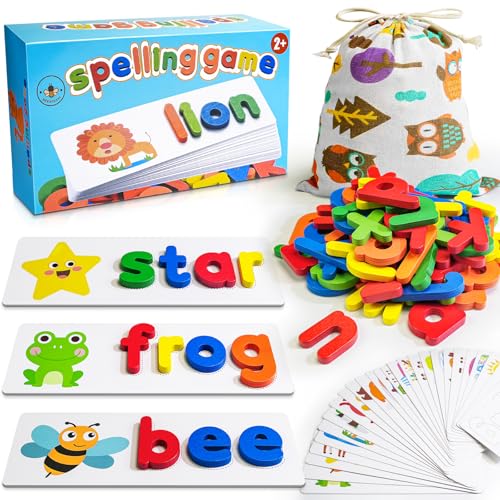
BEESTECH Alphabet ABC Learning Educational Toys for Toddlers | Wooden Puzzles, Flash Cards Matching Games for 3 4 5 Years Old Boys Girls, Preschool Activity Spelling Toys
Check price on Amazon📚 Continue Your Research: If you're exploring educational toys for children slightly older or younger, our age-specific guides provide detailed recommendations. You can also learn about educational games for 3-5 year olds for group play ideas, or explore educational toys for 3-4 year olds for the next developmental stage. For slightly younger children, see educational toys for 2-3 year olds, and for older preschoolers, our educational toys for 4-5 year olds guide covers the next phase of learning through play.