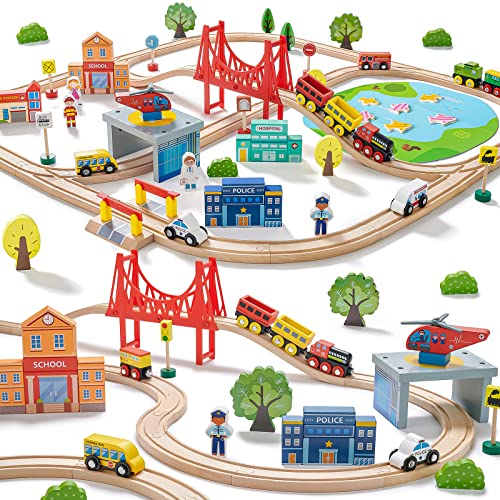
Wooden Train Set: The Complete Guide to Choosing the Perfect Set
Everything you need to know about wooden train sets — from track compatibility and safety standards to developmental benefits and expert buying advice. Make a confident, informed choice for endless hours of creative play.
Explore Top Picks🧠 Why Research Matters: A wooden train set is more than a toy — it's a long-term play investment. Parents and gift-givers researching this category typically want to understand build quality, brand compatibility, safety certifications, and developmental value before committing. This guide answers those questions so you can choose with confidence and avoid common mistakes like buying incompatible tracks or sets that are too advanced for the child's age.
What Makes a Wooden Train Set a Great Choice?
Wooden train sets have remained a childhood staple for generations — and for good reason. Unlike battery-powered toys that entertain passively, a wooden train set invites active construction, spatial problem-solving, and open-ended storytelling. Children physically connect tracks, plan routes, and invent scenarios, which builds fine motor control and creative thinking simultaneously.
The tactile nature of wood also offers sensory benefits: smooth sanded surfaces, satisfying magnetic snaps, and the weight of solid beech or maple pieces create a premium play experience that plastic alternatives often cannot replicate. Many parents appreciate that wooden sets are quieter, more durable, and easier to repair or expand over time. If you are exploring broader options for early construction play, you may also enjoy our guide to wooden toys for 1–2 year olds for age-appropriate starter ideas.
Key Components of a Quality Wooden Train Set
- Track pieces: Straight, curved, and switch tracks made from solid hardwood with precise connector tolerances.
- Magnetic or wooden connectors: Secure couplings that hold trains together during play without frustrating disconnections.
- Engines and carriages: Detailed, painted with non-toxic finishes, and sized to fit standard track gauges.
- Accessories: Bridges, tunnels, stations, level crossings, and signage that expand narrative play.
- Storage solutions: Bins, carry cases, or foldable play tables that simplify cleanup and protect pieces.
Wooden Train Set Tier Comparison: Entry-Level to High-End
Wooden train sets span a wide range of complexity and craftsmanship. To help you compare without focusing on transient market factors, here is a tier-based classification used consistently throughout this guide:
| Tier | Best For | Typical Features |
|---|---|---|
| Entry-Level / Starter Tier | First-time buyers, toddlers aged 2–3, small spaces | Basic oval or figure-eight track, 1–2 trains, simple connectors, lightweight construction |
| Mid-Range / Balanced Tier | Children aged 3–6, expanding collections, family play | Multiple track layouts, bridges, tunnels, 3–5 vehicles, compatibility with major brands, storage bin included |
| Premium / High-End Tier | Dedicated enthusiasts, collectors, multi-child households | Large modular layouts, detailed scenery, durable hardwood construction, extensive accessory packs, table compatibility |
As a general rule, entry-level sets prioritize simplicity and safety for younger children, while mid-range and high-end tier sets introduce more complex routing, richer accessories, and superior material finishing. For families planning to grow a collection over years, investing in a mid-range or premium set with proven cross-brand compatibility is often the wiser long-term choice. Our guide to wooden train tracks with magnetic trains dives deeper into connector systems and expansion options.
Developmental Benefits of Wooden Train Play
🔧 Fine Motor Skills
Connecting tracks, coupling trains, and placing small accessories strengthens hand-eye coordination and dexterity.
🧩 Spatial Reasoning
Designing layouts requires children to visualize shapes, plan routes, and solve track alignment problems.
🎭 Imaginative Play
Stations, tunnels, and role-play scenarios encourage storytelling and narrative thinking.
⚙️ Engineering Basics
Bridges and junctions introduce cause-and-effect thinking and early physics concepts through hands-on experimentation.
🤝 Social Skills
Collaborative track building and shared play help children practice negotiation, turn-taking, and teamwork.
🎯 Focus & Persistence
Completing a track layout or troubleshooting a derailment builds patience and problem-solving resilience.
For children who benefit from targeted skill-building, pairing a train set with toys that help develop fine motor skills can further reinforce the physical coordination that train play naturally encourages.
How to Choose the Right Wooden Train Set
1. Consider the Child's Age and Experience
Children under 3 should only use sets explicitly labeled as safe for their age group — typically those with larger pieces and no small detachable parts. For children aged 3 and up, mid-range sets with bridges and junctions offer the right balance of challenge and accessibility. Older children (6+) often enjoy premium sets with complex layouts and detailed scenery. If you are shopping for a specific age group, see our recommendations for 7-year-old boys and 8–9 year olds to match complexity with developmental stage.
2. Verify Brand Compatibility
One of the most common frustrations is discovering that tracks from different brands do not connect. Before purchasing, confirm the connector style (wooden peg, magnetic, or hybrid) and track gauge. Sticking with a single established ecosystem — or choosing sets explicitly marketed as cross-compatible — saves future headaches. The trains for wooden train sets guide explains rolling stock compatibility in detail.
3. Assess Build Quality and Safety
Look for solid hardwood construction (beech and maple are common), non-toxic water-based paints, and smooth sanded edges. Magnetic connectors should be securely embedded and enclosed. Check for safety certifications relevant to your region and avoid sets with loose small parts if a child under 3 shares the play space.
4. Plan for Expansion
Wooden train sets grow with the child. Choose a starter or mid-range set from a brand with a robust accessory ecosystem — extra track packs, bridges, stations, and themed carriages. This modularity ensures the set remains engaging as the child's skills advance.
5. Factor In Storage and Space
Large layouts need floor space. Consider a dedicated play table or a storage solution that keeps pieces organized. Under-bed storage and foldable play tables are practical for smaller homes. Explore under-bed storage toys for clever space-saving ideas.
💡 Expert Tip: Before buying a large set, start with a starter tier layout and observe how the child plays. Some children prefer building complex tracks; others focus on imaginative train role-play. Matching the set's complexity to the child's play style leads to longer-lasting engagement.
Safety Guidelines for Wooden Train Sets
- Age labeling: Always follow the manufacturer's age recommendation — typically 3+ for sets with small parts.
- Supervision: Young children should always be supervised during play, especially with magnetic connectors.
- Paint and finish: Choose sets with non-toxic, water-based finishes and no peeling or chipping.
- Inspection: Regularly check for loose magnets, splintered edges, or cracked track pieces and remove damaged components.
- Magnet safety: If a magnet becomes detached, keep it away from children immediately — swallowed magnets are a serious hazard.
Wooden Train Set vs. Other Train Systems
Wooden train sets compete with plastic battery-operated systems and die-cast model railways. Wooden sets excel in durability, open-ended construction, and quiet, screen-free play. Battery systems offer lights and sounds but often limit creative track building. Die-cast models prioritize realism for older collectors. For most families with young children, a wooden set offers the best balance of safety, longevity, and developmental value. If you are also considering ride-on options for active toddlers, our wooden ride-on toys for 1 year olds guide covers complementary play categories.
Frequently Asked Questions
What age is a wooden train set suitable for?
Most wooden train sets are designed for children aged 3 and up. Some starter sets with larger pieces suit children from 18 months with adult supervision. Always check the age recommendation on the packaging and ensure small parts are not accessible to children under 3.
Are wooden train sets compatible across brands?
Many wooden train sets follow a standard track and connector design, making them compatible across several major brands. However, compatibility is not universal. Verify connector style and track dimensions before mixing brands.
What are the developmental benefits of wooden train sets?
Wooden train sets support fine motor skills, spatial reasoning, imaginative play, and early engineering concepts. They also encourage patience, persistence, and collaborative social play.
How do I choose the right size wooden train set?
Consider available play space, the child's age and experience, and desired complexity. Starter tier sets suit younger children; mid-range and high-end tier sets with bridges and junctions offer extended play for older children.
Are wooden train sets safe for children?
Quality wooden train sets are safe when used as intended. Look for non-toxic paints, smooth edges, and securely attached connectors. Always supervise young children and follow age and safety guidelines.
Final Thoughts: Investing in Endless Play
A well-chosen wooden train set is a long-term investment in creative, screen-free play. By focusing on build quality, safety, brand compatibility, and age-appropriate complexity, you can select a set that grows with the child and remains a favorite for years. Whether you are buying a first starter set or expanding an existing collection, the tier framework above helps you align expectations with the child's play style and your family's space. For more inspiration on timeless play categories, explore our broader train set collection and related guides.