Trains for Wooden Train Set: The Complete Guide
Choosing the right trains for a wooden train set is about far more than picking a pretty engine. Compatibility, magnetic couplers, durability, and age-appropriate design all shape how well a set performs during play. This guide walks you through everything you need to make a confident, well-informed choice.
Explore Recommended TrainsWhy this guide matters: A wooden railway grows with a child. The engines, cars, and carriages you add determine how easily the layout expands, how reliably the magnetic couplers hold together, and how long the set survives enthusiastic play. If you are still deciding on a foundation, our full wooden train set guide covers track systems, layouts, and starter configurations in detail.
What Makes a Great Train for a Wooden Train Set?
Wooden train systems succeed because they rely on simple, predictable mechanics: interlocking track pieces and magnetic couplers. The trains themselves are the personality of the set, but they also carry the mechanical burden of connecting, rolling, and surviving drops. A great train for a wooden train set balances four characteristics.
1. Coupler Reliability
Magnetic couplers are the heart of wooden train play. Strong, consistently polarized magnets let children connect long trains without frustration, while mismatched or weak magnets cause derailments and tears. Look for trains whose magnets are recessed into the body rather than glued on the surface, since recessed magnets resist prying and last longer. Consistency matters more than raw strength: a coupler that is too aggressive makes it hard for small hands to separate cars, while one that is too weak will not hold a five-car train on a curve.
2. Wheel and Chassis Quality
Wooden trains typically use plastic wheels pressed onto metal axles. The smoothest-rolling models use machined axles and wheels with slight tread patterns, which track better on curves and handle transitions between track sections. Entry-level trains often use simple cylindrical wheels that roll fine on straight track but can bind on tight radius curves. If your layout includes bridges, switches, or steep inclines, wheel quality becomes noticeably more important.
3. Material and Build Durability
Solid hardwood bodies with rounded edges and water-based, non-toxic finishes are the standard for quality wooden trains. Cheaper alternatives may use particleboard or softwood with painted surfaces that chip at the corners after repeated drops. Check that any painted details are sealed under a clear coat, and that small decorative parts, such as smokestacks or roof details, are securely attached rather than press-fit.
4. Age-Appropriate Design
Trains for younger toddlers often feature chunkier bodies, fewer small protruding parts, and simpler shapes. As children move into preschool and early school age, more detailed engines, passenger cars, and specialty cars become appropriate. Always follow the age label on the packaging, and treat it as a safety guideline rather than a suggestion. For a broader look at matching toys to developmental stages, see our guides on toys for 8 and 9 year olds and toys for 7 year old boys.
Understanding Wooden Train Compatibility
One of the most common questions from parents is whether trains from one brand will run on another brand's track. The short answer is that most wooden train systems share a similar track profile and magnetic coupler standard, but compatibility is not universal. The variables that matter are track geometry, connector style, and magnetic polarity.
Track Geometry and Connector Style
Most wooden tracks use a tongue-and-groove or peg-and-hole connection with a consistent height and width. The two dominant connection patterns are the classic interlocking joint and the simpler peg style. A train's chassis height and wheel flange size determine whether it will clear switch mechanisms and bridge ramps. If you plan to combine brands, test a single train on the new track before committing to a large expansion.
Magnetic Coupler Polarity
Magnetic couplers rely on opposite poles attracting. Within a single brand, couplers are oriented consistently, so any two cars connect. Across brands, you may encounter trains where the front magnet is oriented differently from your existing fleet, meaning two cars will repel rather than connect. The practical workaround is to keep a small "adapter car" from a compatible brand in the layout, or to standardize on one brand for engines and rolling stock.
Quick Compatibility Check
Before buying trains for an existing wooden train set, measure the track height and inspect the connector shape. Then check whether the new train's magnetic couplers face the same polarity as your current cars. A two-minute check at the store, or a careful look at product specifications online, prevents most compatibility disappointments.
Tier-Based Recommendations for Wooden Train Engines and Cars
Wooden trains span a wide range of build quality and detail. To help you compare without relying on transient market figures, this guide uses a consistent tier system based on construction, finish quality, and feature set. The tiers below describe relative market position, not absolute value.
| Tier | Best For | Typical Characteristics | Durability Notes |
|---|---|---|---|
| Entry-Level | First train set, casual play, classroom spare parts | Simple shapes, basic painted details, standard magnetic couplers, lightweight bodies | Adequate for gentle play; corners and paint may show wear with heavy use |
| Mid-Range | Growing layouts, mixed-age households, everyday play | Solid hardwood bodies, sealed finishes, smoother wheels, consistent couplers | Good resistance to drops and repeated coupling; a solid long-term choice |
| Premium | Detailed layouts, collectors, heirloom-minded families | Fine painted detail, metal axles, refined coupler alignment, distinctive engine designs | Excellent build quality; finishes and joints hold up well over years of play |
| Top-Tier | Enthusiast layouts, display-quality sets, large collections | Intricate detailing, premium hardwood, precision couplers, specialty rolling stock | Flagship-grade construction; designed for long-term investment and display |
When building out a layout, a common approach is to anchor the set with a mid-range engine and add entry-level rolling stock for volume, or to invest in a premium flagship engine as a centerpiece. The key is consistency: couplers and wheel quality should be similar across the fleet so that long trains behave predictably. For families expanding a starter layout, our guide to wooden train tracks with magnetic trains explains how track geometry and train design interact.
Types of Trains to Add to a Wooden Train Set
A wooden railway becomes far more engaging when it includes variety. Beyond the classic steam engine, consider these categories when expanding.
Engines and Locomotives
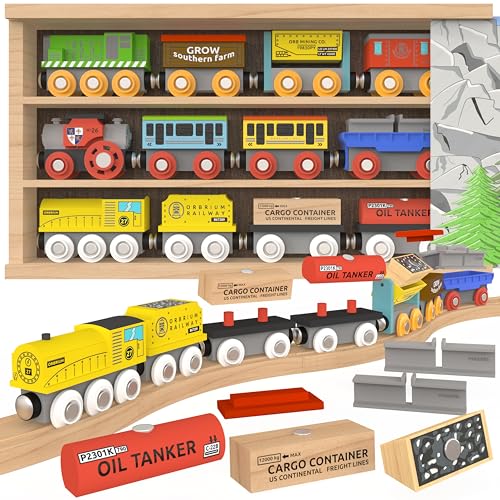
Steam engines, diesel locomotives, and modern electric-style engines form the core of the fleet. Some engines include opening hatches, moving pistons, or tender cars that attach at the rear. For younger children, simpler engines with fewer moving parts are easier to handle.
Passenger Cars and Carriages
Passenger cars introduce narrative play: boarding, seating, and arrival at stations. Look for cars with stable roofs and couplers aligned at consistent heights. Carriages that are too tall can tip on tight curves, so match car height to your track radius.
Freight and Utility Cars
Freight cars, flatbeds, boxcars, and crane cars support loading and unloading play. They are excellent for fine motor practice, especially when paired with a crane or magnetic lifting accessory. Our article on toys that help develop fine motor skills explains why coupling and uncoupling trains is a valuable developmental activity.
Specialty and Seasonal Cars
Holiday-themed cars, animal transport cars, and specialty rolling stock add variety and can make a wooden railway feel fresh across seasons. A festive train around the holidays is a popular way to extend play; see our guide on a train set to go around a Christmas tree for layout inspiration.
Safety and Supervision for Wooden Train Play
Wooden trains are among the safer toy categories, but sensible precautions still apply. Small accessories such as cargo pieces, miniature figures, and connector clips can pose a choking risk for children under three. Check the age label on every train and accessory, and inspect trains periodically for loose magnets, splintered edges, or cracked wheels.
Supervision is especially important when younger siblings join play. A train that is perfectly safe for a five-year-old may include small parts unsuitable for a toddler. Keeping a separate bin of toddler-safe trains is a practical way to include everyone without compromising safety.
Maintaining and Expanding a Wooden Train Collection
Wooden trains are durable, but they benefit from basic care. Wipe wooden bodies with a damp cloth rather than soaking them, and avoid harsh cleaning agents that can dull the finish. Check magnetic couplers periodically for loose magnets, and store trains in a dry bin rather than a damp basement.
When expanding, plan track layout before buying trains. A larger fleet requires more storage and more track to run on. If space is limited, a wall-mounted or under-bed storage solution keeps the collection organized; our guide to under-bed storage for toys offers practical options. For families exploring the broader world of model railways, the train set guide covers electric and hobby-grade systems that pair well with a wooden foundation.
Frequently Asked Questions
Are all wooden train brands compatible with each other?
Most wooden train brands follow a similar track and magnetic coupler standard, so many trains and tracks from different brands can work together. However, exact compatibility varies by brand, so check the connection type and track profile before mixing sets.
What age are wooden train sets suitable for?
Many wooden train sets are designed for children around three years and older, though starter sets with larger pieces may suit younger toddlers with supervision. Always follow the age recommendation on the packaging and check for small parts.
How do magnetic train couplers work?
Magnetic couplers use small magnets at the front and rear of each train car. When cars come close together, the magnets attract and connect them, allowing children to build long trains and take them apart easily during play.
Can wooden trains be used on carpet?
Wooden trains roll best on flat, hard surfaces because tracks and wheels need a stable base. On carpet, tracks can shift and wheels may sink, so a play mat or hard floor is preferable for smooth rolling and stable track connections.
How do I keep wooden train tracks from coming apart?
Track connections stay secure when pieces are fully pushed together on a flat surface. Some brands use interlocking joints or connector clips for extra stability. Checking for worn connectors and replacing damaged track pieces also helps keep the layout intact.