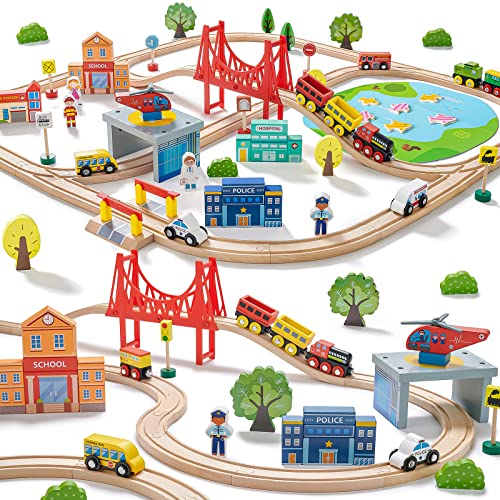
The Complete Train Set Guide for Kids
Everything you need to know before choosing a train set — track types, power options, age suitability, and expert tips to help you find the perfect set for your child's interest and skill level.
EXPLORE TRAIN SET TYPES🚂 Why Train Sets Matter: A train set is more than a toy — it is a hands-on introduction to engineering, spatial reasoning, and imaginative storytelling. Building a track layout teaches problem-solving, while running a train encourages patience and cause-and-effect thinking. Whether you are looking for a first wooden set for a toddler or a detailed model railway for an older child, this guide breaks down every option so you can choose with confidence.
Types of Train Sets Explained
Train sets fall into several distinct categories. Each serves a different age group, skill level, and play style. Understanding the differences is the fastest way to narrow your choice before you explore specific options.
Wooden Train Sets
The most popular choice for early childhood. Wooden tracks use simple push-fit connectors and magnetic couplings, making them safe and easy for small hands. They are compatible across many major brands, so track collections can grow over time.
- Best for ages 2–6
- No batteries required
- Durable construction, smooth edges
- Encourages fine motor skill development
Battery-Powered Train Sets
These sets add motion and sound with a simple battery-powered locomotive. They are an excellent bridge between wooden and electric sets, offering independence without complex wiring. Most use plastic tracks with reinforced connectors.
- Best for ages 3–8
- Simple on/off operation
- Often includes lights and sound effects
- Good value for its tier
Electric & Remote-Control Train Sets
These sets use powered rails or a rechargeable locomotive controlled by a handheld unit. They offer smoother operation and more realistic speed control, making them engaging for older children who want a more immersive experience.
- Best for ages 6–12
- Variable speed and direction control
- Expandable track systems
- Feature-rich for its class
Model Railway & Collector Sets
Detailed scale models built for hobbyists and older children. These sets feature realistic locomotives, finely crafted rolling stock, and modular track systems. They reward patience and precision, and many become long-term collections.
- Best for ages 10 and up
- Highly detailed, premium materials
- Expandable and collectible
- Long-term investment for hobbyists
Which Train Set Fits Your Child's Age?
Age recommendations on packaging are a starting point, not a strict rule. Use this quick guide to match the set type to your child's developmental stage and interests.
Ages 2–3
Choose chunky wooden sets with large pieces and magnetic couplings. Focus on durability and safe, rounded edges. Simple loop layouts work best.
Ages 4–5
Wooden or battery-powered sets with bridges, tunnels, and switches. Children at this stage enjoy building more complex layouts and adding scenery.
Ages 6–8
Remote-control or electric sets with multiple cars and expandable tracks. This is the sweet spot for independent play and creative track design.
Ages 9–12
Model railway sets or advanced electric systems. Older children can handle detailed assembly, wiring, and long-term layout planning.
Train Set Comparison at a Glance
Use this table to compare the main categories side by side. The tier descriptor reflects relative market positioning, not a specific figure.
| Type | Tier | Best For | Power Source | Key Strength |
|---|---|---|---|---|
| Wooden Train Set | Starter Tier | Ages 2–6 | Manual push | Safe, durable, brand-compatible |
| Battery-Powered Set | Essential Tier | Ages 3–8 | Batteries | Independent motion and sound |
| Electric / RC Set | Mid-Tier | Ages 6–12 | Powered rails or rechargeable | Smooth control and expandability |
| Model Railway Set | High-End Tier | Ages 10+ | Powered rails | Realism and collectibility |
What to Check Before You Choose
Beyond the type and age range, a few practical details make a big difference in long-term satisfaction. Keep these points in mind as you compare options.
Track System & Expansion
Check whether the track system is compatible with other sets you already own or plan to add later. Wooden sets from major brands often share connector designs, while electric systems vary more widely. A compatible system means your child's layout can grow without starting over.
Build Quality & Materials
Look for solid build quality, reinforced track connectors, and smooth finishes. Wooden sets should use hardwood with non-toxic paint. Plastic tracks should have sturdy clips that hold firmly without cracking. Metal components should have a rust-proof finish where relevant.
Age Labels & Small Parts
Always follow the age recommendation on the packaging. Sets for children under three should avoid small detachable parts. Check for non-toxic certifications and ensure that powered components are securely enclosed and easy for an adult to access.
Layout Potential & Accessories
The best train sets offer room to grow. Look for sets that include switches, bridges, or level crossings, and check whether additional scenery or rolling stock is available. A set that can be reconfigured in multiple ways keeps children engaged far longer than a fixed loop.
Related Guides for Your Train Set Journey
If you are building out a full play setup, these related guides can help you plan the next step.
- Explore our dedicated guide to the wooden train set for a deeper look at early-childhood options.
- Compare track and coupling systems in our wooden train tracks with magnetic trains overview.
- Looking for rolling stock to expand a layout? See our guide to trains for wooden train sets.
- Planning a holiday display? Read about a train set to go around a Christmas tree.
- For older children ready for more advanced builds, browse our toys for 8 and 9 year olds and toys for 9–12 year olds.
Frequently Asked Questions About Train Sets
What age is a train set suitable for?
It depends on the type. Wooden sets with large pieces are suitable from around age two, while battery-powered and electric sets are generally recommended for ages three and up. Model railway sets are best for ages ten and above due to small parts and detailed assembly. Always check the manufacturer's age label.
Are wooden train sets compatible with other brands?
Many wooden train sets use a similar track connector design, which means they can often be combined across brands. However, compatibility is not universal. Check the connector shape and coupling style before mixing sets from different manufacturers.
Do electric train sets require a lot of setup?
Most electric and remote-control sets are designed for straightforward assembly with clear instructions. Entry-level and mid-range sets typically snap together without tools. Model railway sets may require more careful track alignment and, in some cases, wiring for accessories.
How do I choose between a wooden and a battery-powered train set?
Choose wooden for younger children or for a screen-free, tactile experience that builds fine motor skills. Choose battery-powered if your child wants independent motion and sound without the complexity of an electric system. Many families start with wooden and add a battery-powered set as the child grows.
Can train sets help with child development?
Yes. Building track layouts supports spatial reasoning and problem-solving. Coupling cars and placing track pieces develop fine motor skills. Imaginative play with train sets encourages storytelling and language development. For more on skill-building toys, see our guide to toys that help develop fine motor skills.
Ready to Find the Right Train Set?
Browse our expert-selected recommendations below to compare options and check availability.
VIEW RECOMMENDED TRAIN SETS