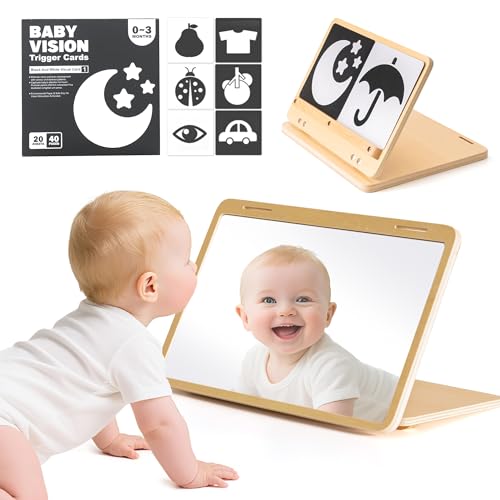
👶 Tummy Time Mirror for Baby – A Simple Tool That Boosts Development
Why put a mirror in front of your baby during tummy time? It’s not just about fun – it’s about building neck strength, encouraging visual tracking, and sparking self-awareness. In this guide, we break down everything you need to know about choosing and using a tummy time mirror safely.
Key Benefits of Tummy Time Mirrors
🧠 Visual Stimulation
High-contrast and reflective surfaces captivate baby’s attention, promoting focus and visual development.
💪 Neck & Core Strength
Babies lift their heads higher and longer to see their reflection, building essential motor muscles.
😊 Self-Recognition
Seeing their own face helps babies develop social and emotional awareness from an early age.
🕒 Extended Tummy Time
Mirrors make tummy time more enjoyable, encouraging longer sessions and more developmental benefits.
What Is a Tummy Time Mirror and Why Does It Matter?
A tummy time mirror is a specially designed, shatterproof mirror that you place in front of your baby during tummy time sessions. Unlike regular mirrors, these are made with infant safety in mind – no sharp edges, no breakable glass, and often with high-contrast patterns around the frame to further engage your baby’s vision.
Pediatricians and child development experts strongly recommend tummy time from birth, and a mirror is one of the most effective tools to make it a positive experience. Why? Because babies are naturally drawn to faces – especially their own! The reflection provides instant feedback, encouraging them to lift their head, push up on their arms, and even start babbling at the "baby" in the mirror.
If you’re looking for other ways to support your baby’s development, you might also explore sensory toys for babies or check out high-contrast toys for babies to complement tummy time activities.
How to Use a Tummy Time Mirror Safely
- Placement: Position the mirror about 10–12 inches from your baby’s face, at eye level.
- Angle: Slightly tilt the mirror so your baby can see their reflection without straining.
- Duration: Start with 2–3 minute sessions and gradually increase as your baby grows stronger.
- Supervision: Always stay close – never leave your baby unattended with any toy or prop.
- Cleanliness: Wipe the mirror with a mild, baby-safe cleaner after each use to prevent germs.
For more tummy time inspiration, read our guide on tummy time activities for babies to keep your little one engaged and developing key motor skills.
Choosing the Best Tummy Time Mirror
Not all baby mirrors are created equal. Here are the essential features to look for:
- 🔒 Shatterproof & Safe: Only choose mirrors made from BPA-free, shatterproof acrylic or PET plastic.
- 🎨 High-Contrast Design: Black, white, and red patterns are most captivating for young infants.
- 📏 Stable Base: A wide, non-slip base ensures the mirror stays upright during active tummy time.
- 🧸 Multi-Sensory Features: Some mirrors include crinkle fabric, soft textures, or teething corners for added stimulation.
- 🧼 Easy to Clean: Look for a smooth surface that can be wiped down quickly.
If your baby is ready for more interactive play, consider pairing the mirror with an activity gym for baby or a tummy time pillow for baby to create a complete play station.
Frequently Asked Questions
At what age can I start using a tummy time mirror?
You can introduce a tummy time mirror from birth. In the first few weeks, babies are attracted to high-contrast patterns and faces. Around 2–3 months, they begin to react more actively to their reflection.
Is a tummy time mirror safe for newborns?
Yes, as long as it is made from shatterproof material and has no small parts. Always supervise your baby during tummy time and never place the mirror directly over the baby’s face.
How do I clean a baby mirror?
Use a soft cloth with warm water and a drop of mild, fragrance-free soap. Avoid harsh chemicals or abrasive sponges that could scratch the surface.
What if my baby doesn't look at the mirror?
Try positioning the mirror at a different angle, or choose one with bold black-and-white graphics on the sides. Some babies take time to notice; consistency and patience are key.
Looking for more ways to support your baby’s early milestones? You might also find our guides on developmentally appropriate toys for 3-month-old and sensory toys for 4-month-old helpful.