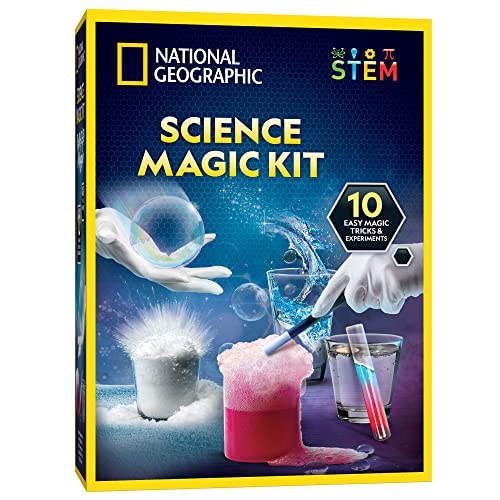
Top STEM Toys for 8 Year Olds: Build, Code, Discover
Eight is a golden age for STEM learning. Your child has the dexterity for intricate builds, the patience for multi-step experiments, and the curiosity to ask "why" about everything. Here are the toys that turn that curiosity into real skills.
Why STEM toys matter at age eight: At this stage, children move from simple cause-and-effect play to genuine problem-solving. The right STEM toy doesn't just entertain — it teaches them to plan, test, fail, adjust, and try again. That cycle is the foundation of every scientific and engineering discipline. Every toy in this guide was chosen because it delivers that cycle in an age-appropriate, genuinely engaging way.
What to Look For in STEM Toys for 8 Year Olds
Before diving into specific recommendations, it helps to understand the developmental benchmarks that make a STEM toy a good fit for an eight-year-old. Children at this age typically have well-developed fine motor control, can follow written instructions with multiple steps, and are beginning to think abstractly about systems and patterns.
Key criteria we used
- Progressive difficulty: The best kits start simple and add complexity, so the toy grows with your child rather than being abandoned after one afternoon.
- Hands-on experimentation: Look for sets that encourage tinkering, rebuilding, and testing hypotheses — not just following a single set of directions.
- Real-world connection: Toys that tie into concepts kids can see in the world around them (motors, circuits, structures) tend to hold attention far longer.
- Safety and durability: Reinforced components, non-toxic materials, and clear age-safety labels are non-negotiable.
- Open-ended potential: The ideal STEM toy can be used in more than one way, inviting creative projects beyond the instruction manual.
For parents exploring broader educational options, our toy guides cover everything from early learning to advanced building sets, and our toy reviews offer hands-on assessments of individual products.
The Main Categories of STEM Toys for 8 Year Olds
STEM toys for this age group generally fall into a handful of well-defined categories. Understanding the differences helps you match a toy to your child's interests and learning style.
1. Building and construction sets
Construction toys remain the backbone of STEM play. For eight-year-olds, look for sets that go beyond static bricks and include gears, axles, pulleys, or motorized components. These introduce mechanical engineering concepts in a tangible way. Sets that are compatible with coding add-ons are especially valuable because they bridge building and programming. If your child already enjoys building, our guide to the tile magnets is a great next step for spatial reasoning.
2. Robotics and coding kits
Beginner robotics kits for eight-year-olds typically use block-based programming interfaces that let kids drag and drop commands to make a robot move, light up, or respond to sensors. These kits teach sequencing, loops, and conditional logic — the building blocks of all programming — without requiring typing fluency. They're among the most rewarding STEM toys because kids see immediate, physical results from their code.
3. Science experiment kits
Chemistry sets, physics kits, and earth science kits give kids a structured way to explore the natural world. At eight, children can handle real measuring tools, follow safety protocols with supervision, and record observations. Kits that include a lab notebook or guided journal are particularly effective because they reinforce the scientific method.
4. Engineering and mechanics sets
These sets focus on how things work — simple machines, structural loads, gear trains, and kinetic energy. They often include real tools (screwdrivers, wrenches) scaled for smaller hands, which adds a satisfying "real work" feel that eight-year-olds love. Our tool sets guide covers related options for hands-on builders.
5. Math and logic puzzles
Not all STEM toys are electronic. Logic puzzles, tangrams, and strategy games build mathematical reasoning and spatial thinking. These are excellent for quiet time and for kids who prefer low-tech, screen-free play. For a broader look at screen-free options, explore our educational toys for younger kids as a foundation.
STEM Toy Categories at a Glance
Use this comparison table to quickly match a category to your child's interests and your family's preferences. Tiers reflect market positioning and complexity, not any specific product.
| Category | Best For | Key Skills | Typical Tier |
|---|---|---|---|
| Building & construction | Kids who love hands-on assembly | Spatial reasoning, structural design | Entry-level to mid-range |
| Robotics & coding | Kids curious about how things think | Sequencing, logic, debugging | Mid-range to premium |
| Science experiment kits | Kids who ask "what happens if…" | Observation, measurement, method | Entry-level to mid-range |
| Engineering & mechanics | Kids who take things apart | Mechanical reasoning, tool use | Mid-range |
| Math & logic puzzles | Kids who enjoy quiet, focused challenges | Pattern recognition, deduction | Entry-level to premium |
How to Choose the Right STEM Toy for Your 8 Year Old
With so many options, the decision usually comes down to three questions: What does your child already enjoy? How much adult involvement is realistic in your household? And what kind of learning do you want to prioritize?
Match the toy to your child's play style
Some eight-year-olds are builders who want to construct and rebuild for hours. Others are experimenters who want to mix, measure, and observe. Still others are coders who light up when they make a screen or robot respond to their commands. Observing how your child plays with existing toys is the fastest way to pick a category that will stick.
Consider the level of adult support
Robotics kits often benefit from a parent co-piloting the first session, while science kits may require supervision for safety. Building sets and logic puzzles tend to be more independent. Be honest about how much time you can invest — a kit that sits unopened because it's too complex for solo play helps no one.
Think about longevity
The strongest STEM toys for this age group have graded challenges or open-ended components that keep them relevant for months or years. A mid-range kit with progressive projects often delivers more long-term engagement than a single-purpose gadget.
For siblings and gift-givers
If you're shopping for a gift, our guides to the top toys for 10 year olds and the top toys for 6-7 year olds help you calibrate difficulty across ages. For a broader gift-hunting framework, see our toy gift guides.
Ready to Explore STEM Toys?
Browse our hand-picked selection of STEM toys for 8 year olds below, or dive deeper into our expert reviews for detailed hands-on assessments.
View Recommended STEM ToysSafety and Supervision Guidelines
STEM toys often involve small components, real tools, or experiment materials, so a few practical safety habits go a long way.
- Check age labels carefully: Most STEM kits for eight-year-olds are rated for ages 8 and up, but always confirm, especially if younger siblings are in the home.
- Supervise experiments: Science kits that involve liquids, heat, or chemical reactions should always be used with adult supervision and in a well-ventilated space.
- Store small parts securely: Building and robotics kits contain tiny pieces that are choking hazards for toddlers. Use labeled storage bins and keep them out of reach of younger children.
- Follow the manufacturer's instructions: Instruction manuals for STEM toys include important safety and usage notes. Read them together with your child before the first session.
For families with younger children, our guides to teething toys and toys for 12 month olds help you keep age-appropriate play separated and safe. And if you're organizing a growing collection, the toy rotation system is a practical way to manage clutter while keeping favorites accessible.
Frequently Asked Questions About STEM Toys for 8 Year Olds
What makes a STEM toy suitable for an 8 year old?
STEM toys for 8 year olds should match their developing fine motor skills, growing attention span, and emerging interest in logical problem-solving. Look for sets with clear step-by-step instructions, opportunities for open-ended experimentation, and challenges that grow with your child. Building sets with moving parts, beginner coding robots, and science kits that involve real measurements are all excellent choices.
How do STEM toys benefit 8 year old development?
STEM toys for 8 year olds support critical thinking, spatial reasoning, fine motor control, and collaborative skills. They encourage kids to form hypotheses, test ideas, and learn from failure in a low-stakes environment. Many children this age are ready to follow multi-step directions and work independently, so kits that offer graded difficulty levels keep them engaged and challenged.
Are building sets considered STEM toys?
Yes. Construction and building sets are among the most fundamental STEM toys. They introduce concepts like structural stability, gear ratios, and mechanical advantage. For 8 year olds, sets that include motors, pulleys, or compatible coding components bridge the gap between simple brick-building and true engineering design.
What should parents check before buying a STEM toy for an 8 year old?
Parents should verify age safety labels, check that small parts are not a choking hazard for younger siblings in the home, and ensure the toy's difficulty level matches the child's reading ability and patience. Reading reviews from other parents and looking for educational endorsements can help confirm that a set delivers genuine learning value rather than just entertainment.
Final Thoughts
The best STEM toy for your eight-year-old is the one that meets them where their curiosity already lives. Whether that's a robotics kit that makes a robot dance, a chemistry set that fizzes and bubbles, or a logic puzzle that clicks into place — the goal is the same: to make thinking feel like play. Use the categories and criteria above as a framework, read our detailed toy reviews for specific products, and don't be afraid to start with an entry-level kit and upgrade as your child's skills grow.