Outdoor Play Equipment for Small Backyards: Big Fun in Tiny Spaces
Your small backyard doesn't have to mean small adventures. Discover compact swings, foldable slides, and space-smart playsets that deliver hours of outdoor activity without swallowing up your entire yard.
If you are researching outdoor play equipment for small backyards, you have likely already browsed the major retailers and know roughly what you want. What you need now is clarity: which categories truly fit a compact footprint, which features justify a step up to a higher tier, and how to install everything safely without sacrificing the rest of your outdoor space. This guide breaks down the options by category and tier so you can move from research to a confident decision.
Why Small Backyards Need Purpose-Built Play Equipment
A standard full-size playset can easily claim a hundred square feet or more once you factor in the safety perimeter and swing arc. In a compact yard, that is simply not realistic. Purpose-built compact equipment solves this by shrinking the frame, shortening the slide runout, and often combining several activities into one vertical unit. The result is a play zone that fits within a patio-sized area while still offering climbing, sliding, swinging, and imaginative play.
Families with younger children often pair a compact climber with a simple sandbox or water table, while families with older kids lean toward foldable sports nets and portable basketball hoops. If you are shopping specifically for a toddler, our guide to outdoor toys for 2-4 year olds covers the low-height, rounded-edge options that work best at that stage. For a broader overview of the category, the main outdoor toys hub is a useful starting point.
Compact Footprint
Vertical climbers and corner-fit swing frames use height instead of width, fitting into spaces as narrow as a single parking spot.
Foldable & Portable
Collapsible slides, inflatable play centers, and pop-up tents can be stowed away when the yard needs to serve another purpose.
Multi-Activity Design
One unit that combines a slide, climber, and play fort replaces three separate pieces of equipment and saves precious ground space.
Anchored Stability
Ground stakes and weighted bases keep lightweight frames secure without requiring a permanent concrete foundation.
Weather-Resistant Build
Rust-proof finishes and UV-stabilized plastics hold up through seasons of sun and rain, even in a small exposed yard.
Age-Scaled Safety
Lower platform heights and smaller gaps suit younger children, while reinforced frames support older kids safely.
The Main Categories of Compact Outdoor Play Equipment
1. Compact Swing Sets and Swing Frames
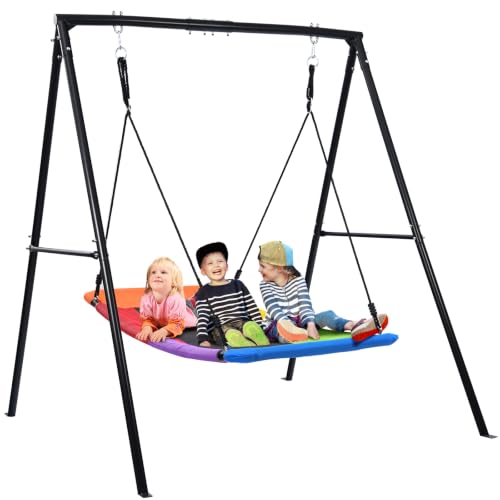
A-frame swing sets are the classic backyard centerpiece, and compact versions shrink the frame span to fit narrow yards. Look for models with a single swing bay rather than a full multi-bay frame, and consider a two-seat glider or a toddler bucket seat paired with an older child's swing. A canopy-topped frame adds shade and extends usable hours in summer. If shade is a priority, a dedicated outdoor swing set with canopy is worth reviewing before you commit to a bare frame.
For families with mixed ages, a frame that supports both a baby bucket and a standard belt swing grows with the child. Freestanding metal frames are generally more stable than wooden frames in a small space because they can be repositioned and re-anchored seasonally. Parents of five- and six-year-olds often find that a single-bay frame with one swing and a trapeze bar covers the most ground. Our guides to outdoor toys for 5 year olds and outdoor toys for 6 year olds go deeper into swing and climber combinations for that age band.
2. Foldable and Compact Slides
A freestanding slide is the single most space-efficient piece of play equipment you can add to a small yard. Foldable slides collapse flat for storage and can be set up on a patio, deck, or lawn in seconds. Entry-level foldable slides suit toddlers, while mid-range models extend to a longer runout and a higher platform for preschoolers. Always check the slide runout distance against your available space, and place a soft landing surface at the bottom.
3. Vertical Climbers and Play Structures
Climbing domes, geodesic climbers, and vertical play towers trade ground area for height. A climbing dome with a six-foot diameter fits in a corner and supports multiple children at once. For a more structured play experience, a compact play tower with a slide and a small platform delivers climbing, sliding, and pretend play in a footprint no larger than a dining table. If you want to explore dedicated playsets rather than standalone climbers, the playsets collection covers the full range from starter towers to larger configurations.
4. Play Tents, Playhouses, and Imaginative Structures
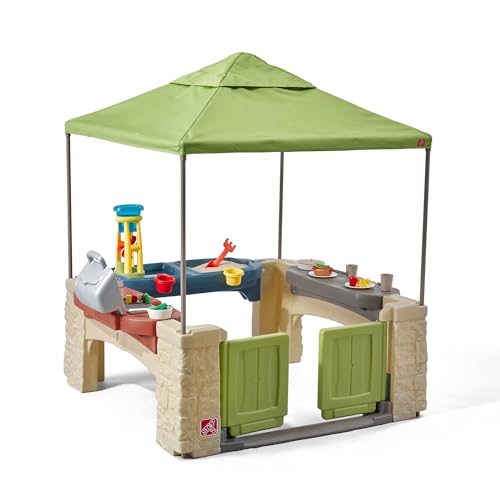
Pop-up play tents and compact playhouses are the lightest and most portable option in this category. They fold into a carry bag, set up indoors or outdoors, and are ideal for renters or families who want flexible play space. A play tent with tunnel and ball pit combines several activities into one collapsible unit and is a strong choice for toddlers. For a more permanent backyard feature, a compact outdoor playhouse adds a dedicated pretend-play zone without the footprint of a full playset.
5. Compact Sports and Active Play Equipment
Older children in a small yard often gravitate toward portable sports equipment: foldable soccer goals, adjustable basketball hoops on wheels, and rebound nets. These store flat against a wall and can be rolled out for play sessions. If you are outfitting a slightly older child, the outdoor toys for 8-10 year olds guide includes active-play options that suit compact spaces, and the outdoor toys for 10-12 year olds guide covers portable sports gear for pre-teens.
Comparing Tiers: Entry-Level Through Premium
Compact play equipment spans a wide range of build quality. The table below groups options by market tier so you can match your choice to how long you plan to keep the equipment and how intensively it will be used. Descriptors reflect relative market position, not any specific figure.
| Tier | Typical Build | Best For | Durability Outlook |
|---|---|---|---|
| Entry-Level | Lightweight plastic, foldable frames, basic anchoring | Toddlers, renters, seasonal use | Good for light use; may need replacement after a few seasons |
| Mid-Range | Reinforced plastic and steel, UV-stabilized components, staked bases | Preschoolers and early school-age kids, year-round outdoor use | Solid multi-season performance with basic maintenance |
| High-End Tier | High-grade steel frames, powder-coated finishes, precision joints | Families with multiple children, long-term backyard installation | Durable construction suited to daily use across several years |
| Premium | Commercial-grade hardware, solid wood or heavy steel, modular expansion | Families treating the playset as a permanent backyard fixture | Long-term investment with the longest service life |
As a general rule, mid-range models usually offer noticeably smoother swing mechanisms and sturdier climbing holds than entry-level options, while high-end and premium tiers add refined finishes and modular expansion potential. For a toddler-focused setup, the difference between an entry-level and a mid-range climber is often the stability of the base and the quality of the plastic molding. Our outdoor toys for 3-4 year olds guide is a good reference for which tier makes sense at that age.
Space Planning Checklist Before You Buy
Measure twice and install once. Use this checklist to confirm your chosen equipment will fit comfortably alongside the rest of your yard's functions.
- Measure the exact footprint of the equipment, including the swing arc and slide runout.
- Add a safety clearance zone of at least six feet on all sides.
- Identify a level, well-drained surface — grass, rubber matting, or mulch.
- Check for overhead hazards such as low branches, power lines, and fence tops.
- Confirm the equipment can be anchored into your surface type.
- Plan a storage spot for foldable items during off-season or bad weather.
Safety Considerations for Compact Installations
Small yards leave less margin for error, so safety deserves extra attention. Always anchor swing frames and climbers according to the manufacturer's instructions, and inspect ground stakes and bolts at the start of each season. For climbing structures, verify that handholds are sized for the intended age group and that guardrails are present on any platform above toddler height. If the equipment sits on a hard surface such as a patio, add a shock-absorbing mat beneath slides and swings.
Age labeling matters more in compact setups because older and younger children often share the same small play zone. A climber rated for ages three to five should not be used by a seven-year-old, even if it physically supports the weight. Supervise mixed-age play and establish simple ground rules for turn-taking on swings and slides.
Frequently Asked Questions
What is the best type of outdoor play equipment for a small backyard?
Compact swing sets, foldable slides, collapsible play tents, and vertical climbing structures are the strongest options. Look for equipment with a small footprint that can be folded away or repositioned easily, and prioritize multi-functional pieces that combine several activities into one space-saving unit.
How much space do I need for a small backyard playset?
Most compact playsets require a footprint of roughly six to ten feet in each direction, plus a safety clearance zone of at least six feet around the structure. Always check the manufacturer's recommended safety perimeter, and account for swing arcs and slide runouts before placing the equipment.
Can outdoor play equipment for small backyards be moved or stored?
Yes. Many entry-level and mid-range options are designed for portability, including foldable slides, inflatable play centers, collapsible tents, and lightweight swing frames. These suit renters or families who reconfigure their yard seasonally, though premium and commercial-grade models are typically permanent installations.
What safety features should I look for in compact outdoor play equipment?
Prioritize rounded edges, non-slip steps, reinforced joints, rust-proof finishes, and anchored bases. Confirm the equipment meets recognized safety standards, includes clear age labeling, and has a stable base that resists tipping. For climbing structures, check that handholds and guardrails are appropriately sized for the intended age group.
Final Thoughts
Outdoor play equipment for small backyards is no longer a compromise. Compact swing frames, foldable slides, vertical climbers, and collapsible play tents deliver the same core experiences — swinging, sliding, climbing, and imagining — within a footprint that respects the rest of your outdoor space. The key is to measure carefully, choose a tier that matches how long you plan to keep the equipment, and anchor everything properly before the first play session.
Start with the category that matches your child's current favorite activity, then expand over time. A foldable slide today can become the foundation for a compact swing frame next season. Browse the recommendations below to compare specific options within the category.