
Climbing Walls for Kids: Build Confidence Through Active Play
Transform your home, playroom, or backyard into an adventure zone. Discover how indoor and outdoor climbing walls help children develop strength, coordination, and problem-solving skills — all while having endless fun.
Explore Buying Guide🧗 Why Climbing Walls? Climbing walls for kids are more than just play equipment — they are developmental powerhouses. Climbing engages every major muscle group, sharpens spatial awareness, and teaches children to assess risk and solve problems. Whether you're considering a compact indoor wall for a playroom or a full outdoor climbing frame for the backyard, this guide covers everything you need to make a confident, well-informed decision.
What Are Climbing Walls for Kids?
A climbing wall for kids is a structured surface equipped with handholds and footholds that allows children to ascend, traverse, and descend in a controlled environment. Unlike commercial climbing gyms, home climbing walls are designed specifically for younger users — featuring shorter heights, softer landing zones, and age-appropriate hold spacing. They range from compact wall-mounted panels suitable for a bedroom or playroom to freestanding outdoor structures that double as a full climbing frames for kids with slides and swing attachments.
The growing popularity of home climbing walls reflects a broader shift toward active, screen-free play. Parents are increasingly seeking children's outdoor play equipment that combines physical challenge with safety. A well-designed climbing wall delivers exactly that — a structured outlet for energy that builds resilience and confidence with every climb.
Types of Climbing Walls for Kids
Understanding the different categories helps you narrow down the right fit for your space, budget tier, and child's age. Here are the main types available:
Wall-Mounted Panels
Compact panels that mount directly to a stud wall in a bedroom, playroom, or garage. Ideal for tight spaces and younger children. These typically feature pre-drilled holes and a set of colorful holds. Best suited for indoor use where floor space is limited but vertical space exists.
Freestanding Indoor Structures
Self-supporting frames that stand on the floor with a wide, stable base. Often A-frame or arch designs with climbing holds on both sides. These are excellent for playrooms and allow multiple children to climb simultaneously. Many include a slide or a children's play tent attachment for extended play value.
Outdoor Climbing Walls & Frames
Weather-resistant structures built for the backyard. These often integrate with swing sets, slides, and children's outdoor play house designs. Constructed from treated wood or heavy-duty metal with rust-proof hardware. Designed for year-round outdoor exposure and larger age ranges.
Custom & Modular Climbing Systems
Configurable wall systems with adjustable hold positions, interchangeable panels, and expandable layouts. These grow with your child and can be reconfigured as skills advance. Often used in commercial indoor play equipment settings but available in residential-scale versions for dedicated home climbing enthusiasts.
Safety First: What Parents Must Know
Safety is non-negotiable when it comes to climbing equipment. A few key principles apply regardless of which type you choose:
- Age-appropriate design: Always follow the manufacturer's age recommendation. Younger children need lower wall heights and larger holds with simpler spacing.
- Impact-absorbing surface: Place a crash mat, foam pad, or loose-fill surfacing (like rubber mulch or sand) beneath the wall. Never install a climbing wall over bare concrete or hardwood.
- Secure mounting: Wall-mounted panels must be anchored into wall studs — never drywall alone. Freestanding units should have a wide base or be anchored to the ground.
- Regular inspection: Check bolts, holds, and structural joints regularly. Tighten loose hardware and replace worn holds promptly.
- Supervision: Young children should always be supervised during climbing. Establish clear rules: no jumping from the top, no climbing without shoes, and one climber at a time on narrow walls.
For families exploring other active play options, a children's swing set with slide can complement a climbing wall and create a complete backyard activity zone. Similarly, children's outdoor play equipment and children's play houses pair naturally with climbing structures for a full adventure setup.
Comparison: Climbing Wall Options by Tier
Use this side-by-side comparison to evaluate which tier best matches your space, child's age, and long-term goals. Each category is classified by market positioning rather than numeric value.
| Category | Tier | Best For | Key Features | Installation |
|---|---|---|---|---|
| Wall-Mounted Panel | Entry-Level | Small rooms, toddlers | Pre-drilled holds, compact footprint, colorful design | Wall stud mounting required |
| Freestanding Indoor Frame | Mid-Range | Playrooms, multiple children | Double-sided climbing, slide attachment, stable base | Assembly required, no wall anchoring |
| Outdoor Climbing Wall | Premium | Backyards, year-round use | Weather-resistant coating, integrated swing/slide, durable construction | Ground anchoring recommended |
| Modular Custom System | Top-Tier | Dedicated climbers, growing families | Adjustable holds, expandable panels, professional-grade hardware | Professional installation advised |
Age-Specific Considerations
Children's physical capabilities vary dramatically across age groups. Here's how to match climbing wall features to developmental stages:
Toddlers (2–4 Years)
At this stage, the focus is on exploration and basic motor skill development. Choose very low walls (under 1 meter), oversized holds, and a soft landing surface. A children's indoor bounce house or padded play mat adjacent to the wall adds a safe transition zone. Freestanding structures with gentle slopes work well — avoid steep overhangs entirely.
Preschoolers (4–6 Years)
Preschoolers are ready for slightly more challenging routes. Introduce color-coded holds to create simple "paths" that encourage problem-solving. A children's play house with an integrated climbing wall is a popular choice at this age, blending imaginative play with physical activity. Look for holds that are easy for small hands to grip and walls that are no taller than 1.5 meters.
School-Age Children (6–10 Years)
This is the prime age for climbing walls. Children have the coordination and strength to tackle more complex routes. Consider a taller wall (1.8–2.5 meters) with varied hold types — jugs, crimps, and slopers — to develop diverse grip strength. Outdoor structures like a children's playhouse with swing and slide often incorporate climbing walls as part of a multi-activity play system, maximizing play value.
Pre-Teens (10–12 Years)
Older children benefit from adjustable or modular systems that can be reconfigured as their skills grow. At this age, climbing becomes a genuine sport. A modular wall with varying angles (slight overhang, vertical, slab) provides appropriate challenge. Pair it with other active children's outdoor play equipment for a complete fitness-oriented backyard.
Installation & Placement Tips
Proper placement maximizes both safety and usability. Consider these practical guidelines before installation:
- Indoor placement: Choose a wall with clear space beneath and to the sides. Avoid placing near windows, furniture with sharp edges, or hard flooring. A garage or dedicated playroom is ideal.
- Outdoor placement: Select a level area with good drainage. Position the wall away from fences, trees, and other structures. Ensure the landing zone is free of rocks, roots, and debris.
- Clearance: Allow at least 1.5 meters of clear space on all sides of the climbing wall. This prevents collisions and provides room for spotters.
- Surface preparation: For outdoor walls, install a proper impact-absorbing surface. Rubber playground tiles, poured rubber, or loose-fill materials like engineered wood fiber are all suitable choices.
- Weather considerations: Outdoor walls should be constructed from weather-resistant materials with rust-proof hardware. Wooden structures should be treated and sealed. Check for splintering and loose hardware seasonally.
Developmental Benefits of Climbing
Climbing is one of the most complete physical activities a child can engage in. The benefits extend far beyond physical fitness:
Physical development: Climbing builds upper body strength, grip strength, core stability, and flexibility. It improves balance and coordination in ways that complement other children's outdoor play equipment activities like swinging and sliding.
Cognitive skills: Route-finding on a climbing wall is a real-time problem-solving exercise. Children learn to plan movements, assess risk, and adapt when a hold doesn't work as expected. This builds executive function and decision-making skills.
Emotional resilience: Climbing involves manageable risk. Children learn to push their comfort zone, recover from minor setbacks, and celebrate progress. The sense of accomplishment from reaching the top of a wall is a powerful confidence builder.
Social skills: Climbing walls naturally encourage turn-taking, spotting (watching out for a partner), and cooperative play. Siblings and friends often create games and challenges together on the wall.
Maintenance & Long-Term Care
A well-maintained climbing wall will provide years of safe play. Follow these care practices:
- Monthly inspections: Check all bolts, screws, and holds for tightness. Look for cracks, splinters, or signs of wear.
- Hold rotation: Rearrange holds periodically to create new routes and maintain engagement. This also distributes wear more evenly.
- Cleaning: Wipe down holds and panels with a mild soap solution. Avoid harsh chemicals that may degrade surfaces.
- Seasonal care (outdoor): Before winter, inspect for loose hardware and apply a protective sealant to wooden components. After winter, check for frost damage or rust.
- Crash pad upkeep: Replace worn foam mats or replenish loose-fill surfacing as needed to maintain impact absorption.
Frequently Asked Questions
What age is appropriate for a home climbing wall?
Children as young as 2–3 years can use very low climbing walls with large holds and close adult supervision. However, most manufacturers recommend a minimum age of 3–4 years for wall-mounted panels and 5–6 years for taller freestanding structures. Always follow the manufacturer's age guidelines and assess your child's individual readiness.
Do I need a professional to install a climbing wall?
Wall-mounted panels can typically be installed by a competent DIYer with basic tools, provided the wall studs are properly located and the hardware is rated for the load. Freestanding structures require assembly but no wall anchoring. Modular or custom systems may benefit from professional installation to ensure structural integrity and safety.
What surface should go under a climbing wall?
Impact-absorbing surfacing is essential. For indoor walls, a thick foam crash mat or padded gym mat works well. For outdoor walls, rubber playground tiles, poured rubber surfacing, or loose-fill materials like engineered wood fiber provide appropriate shock absorption. The depth and type of surfacing should match the wall height — taller walls require more shock-absorbing capacity.
How much space do I need for a climbing wall?
A compact wall-mounted panel can fit on a single wall section of about 1.2 meters wide by 1.8 meters high, with 1.5 meters of clear space in front. Freestanding frames require a footprint of roughly 1.5 x 1.5 meters plus clearance. Outdoor climbing structures integrated with swing sets or slides need significantly more space — typically a 3 x 3 meter area or larger.
Can climbing walls be used indoors and outdoors?
Indoor walls are designed for interior use with materials and finishes suited to climate-controlled environments. Outdoor walls are built with weather-resistant materials, treated wood, and rust-proof hardware. While some modular systems are convertible, it's generally best to choose a wall specifically designed for your intended environment to ensure longevity and safety.
How do I choose the right holds for my child?
Younger children benefit from large, positive holds (jugs) that are easy to grip. As skills develop, introduce smaller holds and varied shapes to challenge different grip types. Color-coding holds helps children follow routes and adds a problem-solving element. Ensure holds are securely fastened and free of sharp edges or rough textures.
Ready to Build Your Child's Climbing Adventure?
A climbing wall is an investment in your child's physical development, confidence, and love of active play. Whether you choose a compact indoor panel or a full outdoor climbing structure, the key is matching the design to your child's age, your available space, and your safety requirements.
For complementary play equipment that pairs perfectly with a climbing wall, explore our guides on children's outdoor play equipment, climbing frames for kids, and children's swing sets with slides. Together, they create a complete backyard adventure zone that children will enjoy for years.
Recommended Climbing Walls for Kids
⚠️ AFFILIATE DISCLOSURE: This website contains affiliate links. As an Amazon Associate, we earn from qualifying purchases. If you make a purchase through these links, we may receive a small commission at no additional cost to you. Read our full affiliate policy.
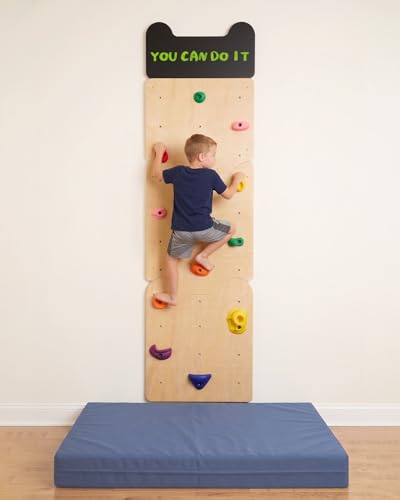
noblequest Wooden Rock Climbing Wall for Kids, Indoor Climbing Wall Panels | With 12 PP Rock Holds, Customizable Routes Climbing Toy for Playroom Home Gym, Adjustable for 3+ Years
Check price on Amazon
Cofiyard 9-in-1 Swedish Ladder Wall Gym & Climber, 94.5'' Wooden Wall-Mounted Climbing Set with Double-Sided Slide, Swing, Rope, Rings, Monkey Bars, Kids Indoor Playset, Wooden Climbing Jungle Gym
Check price on Amazon
Avenlur Walnut 9-in-1 Swedish Ladder Wall Gym Set - 94.5 Inches - Trapeze Swing, Rope Ladder, Rock Wall, Rope Wall, Rock Ramp Climber, Slide, Pull-up Bar, Ladder and Swing
Check price on Amazon
Teyva Daily 6 x 2 ft Climbing Wall Panels for Home Gym Wooden Indoor Climbing Wall Panels with Removable Pull-up Bar for Home Playground Playrooms Montessori Rooms Sensory Spaces
Check price on Amazon
VEVOR Indoor Jungle Gym for Toddlers, 7-in-1 Climbing Playset, Multicolor | For Kids, Supports 220 lbs, with Carbon Steel Swedish Ladder, Wall Ladder, Pull-Up Bar, Rope Ladder, and Gymnastic Rings
Check price on Amazon
NEATATOU 32 PCS Rock Climbing Holds for Kids,Rock Climbing Wall Grips Climbing Rocks Wall Kit for Indoor and Outdoor Playground Play Set with Hardware (Style A)
Check price on Amazon
32Pcs Rock Climbing Holds for Kids, Climbing Wall Grips for Playground | Hold Up to 230lbs, Rock Climbing Wall Pieces Indoor and Outdoor, Playset Accessories for Kids Adults, Single Hole, Age 3+
Check price on Amazon