
RC Planes Ready to Fly for Sale: The Complete Beginner Buyer's Guide
If you are researching radio-controlled aircraft, you have probably noticed that most beginner-friendly planes are sold as ready to fly packages. This guide explains exactly what comes in the box, how RTF planes differ from kit and ARF formats, and which specifications actually matter before you commit to your first model.
Explore Ready-to-Fly OptionsWhat "Ready to Fly" Really Means
Ready to fly, commonly abbreviated as RTF, is a product format rather than a skill level. An RTF package is designed so that the buyer receives a complete, airworthy aircraft with the transmitter, receiver, flight battery, and charger already matched to the airframe. In most cases the wing, tail surfaces, and landing gear arrive detached for shipping and simply need to be secured with the included hardware.
The practical benefit is that you avoid the two biggest sources of frustration for new hobbyists: component mismatch and radio binding. When a manufacturer sells a complete RTF package, the electronics have been tested together, the center of gravity has been specified, and the control throws are documented in the manual. That structure is why RTF planes are the default recommendation for anyone moving from research into their first purchase.
It is worth understanding what RTF does not mean. It does not mean the plane is indestructible, and it does not mean you can skip a pre-flight inspection. It also does not mean the aircraft is automatically suitable for a small backyard. Most RTF trainers still require a genuinely open flying area, and the larger models in the category need a dedicated club field.
Key distinction: RTF refers to how much assembly and electronics setup is included, not to how easy the aircraft is to fly. A high-performance RTF jet is still a high-performance jet. Always match the airframe class to your experience level, not just the packaging format.
RTF vs ARF vs Kit: Choosing the Right Format
The RC aircraft market uses a small set of format labels, and understanding them will save you from buying something that does not match your intentions. The three formats you will encounter most often are RTF, ARF, and traditional kits.
- RTF (Ready to Fly): Includes the airframe, motor or engine, speed controller or servos, radio transmitter and receiver, flight battery, and charger. Minimal assembly is required, usually under an hour.
- ARF (Almost Ready to Fly): Includes the assembled airframe but typically requires you to supply your own radio system, servos, motor or engine, and battery. Assembly and setup time is measured in hours rather than minutes.
- Kit: A box of balsa or foam parts that you build from scratch. This is a rewarding path for experienced builders but a poor starting point for someone who wants to fly this season.
For a first aircraft, RTF is almost always the correct choice. It keeps the learning curve focused on flying rather than on soldering, programming, and mechanical assembly. If you already own a compatible transmitter from another hobby, ARF can be a sensible second purchase because you can reuse your radio gear and avoid paying for a second transmitter. For a broader look at how radio-controlled vehicles are packaged across categories, the adult RC helicopter guide follows a similar RTF-versus-BNF logic.
Specifications That Matter Most
Product listings for RC planes are dense with numbers, and not all of them carry equal weight. The following specifications are the ones that most directly determine whether a plane suits you.
- Wingspan: The single best indicator of flight characteristics. Smaller wingspans are more affected by wind and fly faster; larger wingspans are more stable and easier to see at distance. Beginner trainers commonly sit in a moderate wingspan range that balances stability with transportability.
- Flying weight: Lighter aircraft survive minor mishaps better and need less speed to stay airborne. Heavier aircraft handle wind more confidently but demand more skill on landing.
- Wing loading: The relationship between weight and wing area. Low wing loading produces a gentle, floaty glide; high wing loading produces a faster, more demanding aircraft. Trainers are designed around low wing loading.
- Motor and propeller setup: Electric RTF planes usually specify a brushless motor, which is more durable and efficient than a brushed alternative. Propeller size and pitch affect thrust and top speed.
- Battery chemistry and capacity: LiPo batteries are the standard for electric flight. Capacity affects flight duration, while cell count affects voltage and therefore power.
- Radio protocol and range: A modern 2.4 GHz system is the baseline expectation. Some RTF packages include transmitters with multiple model memory, which is useful if you plan to add a second aircraft later.
- Flight stabilization: Many beginner-friendly RTF planes include a gyro or self-leveling mode. These features genuinely reduce crash risk, but they should be treated as a learning aid rather than a permanent substitute for stick skills.
If you are also considering ground vehicles, the specification logic is similar; the 1/10 scale rock crawler overview explains how scale, gearing, and electronics choices interact in the same way.
Trainer, Sport, and Scale Planes
Within the RTF category, aircraft are usually grouped by their intended role. Understanding these groups helps you avoid buying a plane that is technically RTF but not appropriate for a first flight.
- Trainers: High-wing designs with generous dihedral, gentle stall characteristics, and low wing loading. These are the planes that forgive a late correction or a slightly hot landing. Most first-time buyers should start here.
- Sport planes: Lower wing loading than trainers and more responsive controls. They reward smooth inputs and punish sloppy ones. A reasonable second aircraft once you can take off, circuit, and land consistently.
- Scale and warbird models: Detailed replicas of full-size aircraft. They look impressive but often carry higher wing loading and less forgiving stall behavior. These are not beginner aircraft, even when sold as RTF.
- Gliders and sailplanes: Designed to fly on rising air rather than continuous motor power. They teach energy management and are excellent for calm evenings, but they require more patience than a powered trainer.
The same tier logic applies across the hobby. If you enjoy scale realism on the ground, the RC semi truck and trailer overview shows how detail-focused models trade simplicity for authenticity.
Entry-Level, Mid-Range, and Premium Tiers
RC planes are best compared by market tier rather than by any single figure. The tier system below describes relative positioning and build quality, and it remains meaningful regardless of how the market shifts over time.
| Tier | Typical Characteristics | Best For |
|---|---|---|
| Entry-level | Foam airframe, brushed or basic brushless motor, simple 3-channel or 4-channel radio, basic charger included | Absolute beginners and casual flyers who want low-risk first flights |
| Mid-range | Reinforced foam or composite structure, brushless power system, better servos, gyro stabilization, multi-model transmitter | Buyers who want a plane they can grow with for two or three seasons |
| Premium | High-grade foam or balsa construction, premium electronics, detailed scale finish, advanced telemetry or GPS features | Experienced pilots seeking scale realism and long-term durability |
A mid-range trainer is often the most sensible long-term investment for a first purchase. Entry-level planes are excellent for testing whether the hobby holds your interest, but their electronics and airframes tend to have shorter service lives. Premium models are built to last but assume skills that most first-time buyers have not yet developed.
Electric vs Nitro Power
RTF planes are available in both electric and nitro configurations, and the choice affects almost every part of your ownership experience.
Electric RTF planes are the dominant choice for beginners. They start instantly, produce no exhaust residue, run quietly enough for many parks, and require only a charged battery and a safe charging routine. The trade-off is that flight time is limited by battery capacity, and LiPo batteries need proper storage and handling discipline. A spare battery is the single most useful accessory you can add to an electric RTF package.
Nitro RTF planes use a small glow engine burning a methanol-based fuel. They offer longer flight sessions, a distinctive sound, and no dependence on battery charging between flights. In exchange, they require engine break-in, fuel handling, tuning, and considerably more cleanup. If the mechanical side of the hobby appeals to you, nitro can be rewarding; if you mainly want to fly, electric is the more practical route. The ready-to-run nitro RC car guide covers the same tuning and maintenance trade-offs for ground vehicles.
Practical note: If you choose electric, buy at least two flight batteries and a parallel or multi-port charger. Flight time is the most common frustration for new electric pilots, and a second battery solves it more effectively than any other single purchase.
Your First Flight Checklist
Most beginner crashes are caused by preparation gaps rather than flying skill. Working through a consistent checklist before every flight dramatically improves your odds of a successful session.
- Read the manual completely. Pay particular attention to the center of gravity range and the recommended control throws.
- Charge the flight battery and the transmitter. Confirm the charger is set to the correct chemistry and cell count.
- Perform a range check. With the plane restrained, walk away while moving the controls and confirm there is no interference or dropout.
- Check control directions. Aileron, elevator, and rudder must move in the correct direction. A reversed elevator is the most common cause of a first-flight loss.
- Inspect the airframe. Look for loose hinges, cracked foam, loose propellers, and any hardware that shifted during transport.
- Choose the right conditions. Fly in light wind, ideally early morning or late evening, and avoid flying near people, roads, or power lines.
- Fly with an instructor if possible. A local club or an experienced friend can save you a great deal of repair time.
If you are also exploring water-based RC hobbies, the gas-powered RC boat guide outlines a comparable pre-run routine for marine models.
Practical Buying Tips
Before you commit to any RTF plane, a few checks will protect your investment and your first flying season.
- Confirm parts availability. Propellers, landing gear, and wings are the parts you are most likely to need. A model with a strong spare-parts catalog is a far better long-term choice than one with no support.
- Check the manual before you buy. Many manufacturers publish manuals online. If the manual is thin or unclear, the product support is likely to be similar.
- Match the plane to your flying site. A large trainer is difficult to launch from a small park. Be honest about where you will actually fly.
- Prefer a modern radio protocol. A 2.4 GHz system with model memory gives you room to add a second aircraft without buying another transmitter.
- Look for stabilization you can turn off. Self-leveling modes are valuable for learning, but you want the option to fly without assistance once your skills develop.
- Consider the whole package. A slightly better transmitter or a second battery included in the box can be more valuable than a marginal difference in airframe specification.
If your interests overlap with surface vehicles, the brushless motor guide for RC cars explains the power-system concepts that carry over directly to electric aircraft.
Ready-to-Fly RC Planes Worth Considering
⚠️ AFFILIATE DISCLOSURE: This website contains affiliate links. As an Amazon Associate, we earn from qualifying purchases. If you make a purchase through these links, we may receive a small commission at no additional cost to you. Read our full affiliate policy.

LEAMBE 4 Channel RC Plane, Ready to Fly Aerobatic Aircraft, Easy Control for Beginners, P51 Mustang RC Airplane Best Gift for Adults
Check price on Amazon
LEAMBE 4 Channel RC Plane - Ready to Fly Aerobatic Aircraft, Easy Control for Beginners, F4U Corsair RC Airplane Best Gift for Adults
Check price on Amazon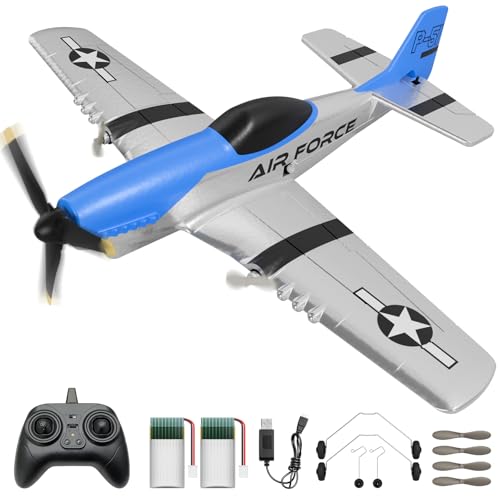
AIGIMU 3CH P-51 RC Airplane with 6-Axis Gyro for Beginners, Ready to Fly | Dual motors, 2 speed modes, hand-launch or glide takeoff, 40+ min runtime, 500 ft range, 2.4GHz control, durable EPP foam
Check price on Amazon
LEAMBE 4 Channel RC Plane, Ready to Fly Aerobatic Aircraft, Easy Control for Beginners, P51 Mustang RC Airplane for Adults Blue-Red
Check price on Amazon
AIGIMU 2CH C17 RC Airplane with 6-Axis Gyro for Beginners, Ready to Fly | Dual motors, hand-launch or glide takeoff, 40+ min runtime, 500 ft range, 2.4GHz control, durable EPP foam
Check price on Amazon
HAWK'S WORK 2CH RC Glider, Easy Fly RC Plane for Kids & Beginners (Blue) | 2.4GHz anti-interference, stable flight, crash-resistant foam, RTF for kid beginners, Ready to fly out of box
Check price on Amazon
DEERC Z67 RC Plane for Kids & Adults,3-CH Remote Control Airplane Toys RTF | Ready-to-Fly EPP Foam Luxury Private Jet Design Toy with 6-Axis Gyro,2 Batteries for Beginners,360° Stunt Rolls,Display Stand
Check price on Amazon
AIGIMU 3CH P-51 RC Airplane with 6-Axis Gyro for Beginners, Ready to Fly | Dual motors, 2 speed modes, hand-launch or glide takeoff, 40+ min runtime, 500 ft range, 2.4GHz control, durable EPP foam
Check price on AmazonFrequently Asked Questions
What does ready to fly mean for RC planes?
Ready to fly, or RTF, means the plane arrives nearly fully assembled with a transmitter, receiver, battery, and charger included. You typically only need to charge the battery and attach the wing or landing gear before your first flight.
Are RTF RC planes good for beginners?
Yes. RTF planes remove the guesswork of matching components and are usually tuned for stable, forgiving flight. They are the most sensible starting point for someone who has never flown a radio-controlled aircraft.
How much space do I need to fly a beginner RC plane?
Most entry-level and mid-range RTF planes need a large open field roughly the size of a soccer pitch, free of trees, power lines, and people. Smaller micro planes can fly in a park, while larger models require a dedicated flying field.
Can RC planes be repaired after a crash?
Many beginner planes use foam airframes that can be repaired with foam-safe glue and replacement parts. Checking parts availability before you buy is one of the most practical ways to protect your long-term investment.
Ready to Choose Your First Plane?
Review the ready-to-fly options above, confirm the flying area near you, and start with a trainer-class airframe. A sensible first choice makes the entire hobby more enjoyable.
View Ready-to-Fly Planes