Residential Outdoor Playground Equipment: The Complete Buyer's Guide
Everything you need to know before choosing backyard play equipment — safety zones, materials, age ratings, layout planning, and the features that matter most for years of active outdoor play.
Start the Buying GuideWhy this guide matters: A residential playground is one of the largest and longest-lasting play purchases a family makes. The right choice delivers years of outdoor activity, physical development, and imaginative fun. The wrong choice means safety worries, wasted yard space, and a structure that outgrows your children too quickly. This guide walks you through the decision step by step so you can choose with confidence.
What to Look For in Residential Playground Equipment
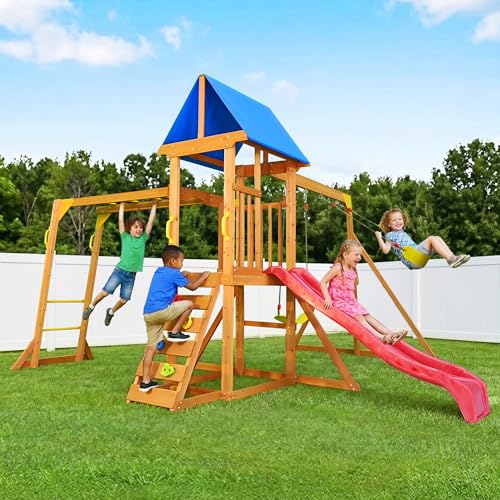
Residential outdoor playground equipment differs from public park structures in important ways. Home sets are sized for a family yard, designed for a handful of children at a time, and built to be assembled and maintained by homeowners. That means your priorities should center on durable construction, sensible footprint, age-appropriate features, and a safety-first layout.
Before comparing individual models, evaluate four fundamentals:
- Age range of your children: A set that suits a toddler will not challenge an eight-year-old. Many families choose modular sets that can grow with their kids, or plan to add stations over time.
- Available yard space: The play structure itself is only part of the footprint. You also need a clear safety zone around it — typically several feet on every side and more in front of slides and swing arcs.
- Ground surface and anchoring: Grass alone does not provide adequate fall protection. Engineered wood fiber, rubber mulch, and poured rubber surfacing are common choices for a home play area. Anchoring the set into the ground or weighting it per the manufacturer's instructions is essential.
- Material and finish quality: Weather-resistant coatings, rust-proof finishes, and reinforced joints separate sets that last a decade from those that wobble after two summers.
Families with very young children often start with a smaller, lower platform. If you have a toddler and a school-age child, consider a children's playhouse with swing and slide for the younger child alongside a larger frame, or choose a modular set with a toddler station and an older-kid tower. For households with a broad age spread, our guide to outdoor play equipment for 2–5-year-olds covers how to bridge those stages safely.
Understanding Market Tiers: Starter to Commercial-Grade
Residential playground equipment generally falls into three recognizable tiers. Understanding them helps you match the structure to your children's ages, your yard, and how long you plan to keep it. Rather than focusing on any single number, think about the position in the market each tier occupies.
Starter Tier
Compact, lighter frames with a single tower, a short slide, and a two-position swing beam. A solid choice for toddlers and small yards. Best suited to families testing the waters or with only one or two young children.
Mid-Range Tier
Larger footprints with multiple stations, climbing walls, a higher slide, and a wider swing beam. Materials are upgraded for better weather resistance. A balanced option for families with kids of mixed ages.
Premium / Commercial-Grade Tier
Heavy-duty frames, reinforced joints, high-grade steel or thick timber, and multi-level play systems. Engineered for long-term use and often modular. The right fit if you want a long-term investment for a large family.
Residential Playground Comparison at a Glance
| Category | Best For | Material Emphasis | Typical Footprint |
|---|---|---|---|
| Starter Tier | Toddlers and small yards | Heavy-duty plastic and treated timber | Compact |
| Mid-Range Tier | Mixed-age families | Wood with rust-proof hardware; reinforced joints | Moderate |
| Premium Tier | Large families, long-term use | High-grade steel, premium timber, weather-resistant coating | Large |
| Commercial-Grade Residential | Very active households, extended lifespan | Heavy-duty steel, commercial fittings, solid build | Extra large |
Materials: Wood, Steel, and Heavy-Duty Plastic
Wood
Wood remains the classic choice for backyard playsets because it looks natural and can be treated for years of weather resistance. Look for timber that is pre-stained or sealed, with reinforced joints rather than simple screws. Wooden towers integrate well with garden landscaping and can be stained or repainted over the years. The main caution is maintenance: inspect for splintering, rot, and loose fasteners annually.
High-Grade Steel
Steel frames — especially those with a rust-proof finish and high-grade hardware — are the gold standard for swing beams and structural uprights. A steel A-frame swing set with heavy-duty legs is far more stable than a lightweight alternative. Many premium residential sets combine a steel swing frame with timber towers, getting the best of both materials. For a standalone swing solution, a heavy-duty metal swing set frame philosophy applied to a family-sized model gives you a sense of the durability to expect.
Heavy-Duty Plastic
High-density polyethylene components are weather-resistant, easy to clean, and forgiving for younger children. Plastic slides, panels, and climbing elements are common across all tiers, but the quality varies enormously: thicker walls, UV-stabilized color, and reinforced mounting points define the durable end of the category.
Combination Builds
Most well-designed residential playgrounds use a combination: steel brackets and fasteners, timber or steel uprights, plastic play panels, and a mix of slide and swing materials. The key marker of quality is whether the joints and fasteners are rated for the loads the structure will see. Reinforced brackets and through-bolts are the signs of a solid build.
Safety Essentials for a Backyard Playground
Safety is not a feature you add later — it is a property of the whole installation. Address these points before the first play session:
- Age-appropriate stations: Younger children need lower platforms, gentler slides, and enclosed bucket swings. Older children can handle climbing walls, taller slides, and open swings. If your children span age groups, choose a set with clearly separated zones or add stations gradually.
- Fall-safe surfacing: The ground under and around the equipment should absorb impact. Engineered wood fiber, rubber mulch, or poured rubber are all suitable; plain grass or concrete are not. Extend the surfacing to cover the full slide exit and swing arc.
- Clear safety zone: Keep the area around the structure free of fences, tree branches, garden furniture, and hard landscaping. Slides and swings need extra clearance in their direction of travel.
- Anchoring: Ground anchors or weighted bases prevent tipping. Follow the manufacturer's anchoring instructions exactly; do not improvise with alternative hardware.
- Routine inspection: Check bolts, swing hardware, slide connections, and timber condition at the start of each season. Tighten or replace worn parts immediately.
- Supervision: Even the safest set requires adult supervision, particularly for children under six.
For a broader look at how play equipment scales with age, see our guide to outdoor play equipment for 12-year-olds to understand when a structure may need to be supplemented or replaced as children grow.
Planning Your Yard Layout
A thoughtful layout is what makes a home playground feel like a destination rather than an obstruction. Start with a simple sketch of your yard and mark these elements:
- Structure footprint: The assembled dimensions of the set, including the swing beam overhang and slide exit.
- Safety buffer: A clear perimeter around the structure, with extra depth where children will land or run out.
- Access path: A clear route from the house to the play area, ideally without steps or obstacles.
- Sun and shade: Some shade is welcome in summer, but avoid low branches near the tower and swing arcs.
- Drainage: Play areas should not collect standing water; a slightly raised or well-drained zone keeps surfacing usable after rain.
If your yard is modest, a compact playhouse or a lower tower with a single slide can deliver most of the play value without overwhelming the space. For smaller children specifically, our roundup of great outdoor toys for 4-year-olds includes several compact structures that fit comfortably in a family garden.
Age-by-Age Recommendations
Toddlers (Ages 2–3)
Prioritize low platforms, enclosed bucket swings, gentle slides, and easy-grip handholds. Avoid high climbing walls and open swing seats until children can balance and grip confidently. A small playhouse or a starter tower with a short slide is often ideal at this stage.
Preschoolers (Ages 3–5)
This is the sweet spot for a first full playset. Look for a mid-range tower with a slide, a two-position swing beam (one bucket, one belt seat), and a small climbing element. The goal is confident, supervised exploration without excessive height.
School-Age (Ages 6–12)
Older children want challenge: climbing walls, monkey bars, higher slides, and swing beams that can take a running jump. A premium or commercial-grade residential set earns its keep here, especially for families with multiple children. If you also want ride-on fun alongside the playset, browse our electric ride-on toys for 6-year-olds for complementary outdoor options.
Assembly, Installation, and Long-Term Care
Most starter-tier and many mid-range sets are designed for home assembly, typically with two adults and basic hand tools. Allow a full weekend, lay out all parts first, and follow the instructions in order — especially the anchoring step. Premium and commercial-grade residential sets are heavier and more complex; professional installation is a worthwhile investment at that tier.
Maintenance is straightforward but non-negotiable:
- Inspect hardware and tighten bolts at the start of each season and after storms.
- Reapply sealant or stain to timber components as recommended.
- Rake and top up loose-fill surfacing to maintain depth.
- Clean plastic and metal components with mild soap and water.
- Check swing chains, hangers, and slide connections for wear.
A well-maintained set with durable construction can serve a family for many years and often through more than one child — which is why treating it as a long-term investment pays off.
Frequently Asked Questions
What is the best material for residential outdoor playground equipment?
Wood, high-grade steel, and heavy-duty plastic each have trade-offs. Wood offers a natural look and solid build when treated for weather resistance. High-grade steel with a rust-proof finish delivers long-term durability for swing sets and frames. Heavy-duty plastic is the most forgiving for younger children. Many premium residential sets combine these materials for the best balance of safety, longevity, and aesthetics.
How much space do I need for a backyard playground?
As a general guideline, plan for a safety zone of at least six feet on all sides of the equipment, and more in front of slides and swings. Compact starter-tier sets can work in modest yards, while premium multi-station playsets with towers, swings, and slides need a larger footprint. Always measure your yard and map the layout before committing to a model.
What age range is residential playground equipment designed for?
Most residential outdoor playground equipment is designed for children roughly ages 3 to 12, with specific stations rated for different age bands. Toddler-friendly sets emphasize low platforms and gentle slides, while top-tier playsets for older kids add climbing walls, taller towers, and swing beams. Check the manufacturer's age rating for each component before buying.
Should I install residential playground equipment myself or hire a professional?
Many entry-level and mid-range sets are designed for DIY assembly with basic tools, though a second adult is usually required. Premium and commercial-grade residential sets are heavier and more complex, so professional installation is often the safer route. Whichever you choose, follow the manufacturer's anchoring instructions precisely and verify the ground surface meets fall-safety guidelines.
Can I add stations to a residential playground later?
Yes — modular designs allow you to add a swing beam, climbing wall, or slide as your children grow. Check that the original frame and anchoring are rated for the additional load, and keep the safety zone clear as the footprint expands.