Must-Have Toys for 8 Month Old: The Complete Development Guide
Your 8-month-old is sitting, reaching, babbling, and exploring everything within arm's reach. Discover the toys that truly support this critical developmental window — chosen by child-development experts and loved by parents.
🧸 Why 8 months is a golden play window: At eight months, babies are typically mastering independent sitting, transferring objects between hands, and beginning to understand cause and effect. The right toys at this stage do more than entertain — they build neural pathways for fine motor control, spatial awareness, and early problem-solving. This guide cuts through the noise and focuses on what genuinely matters.
What Is Your 8-Month-Old Baby Doing Right Now?
Before choosing toys, it helps to understand the developmental milestones that define this age. Every baby develops at their own pace, but most 8-month-olds share a recognizable set of emerging skills. Recognizing these helps you match toys to ability rather than simply to age.
Key Developmental Milestones
- Independent sitting: Many babies can sit without support for extended periods, freeing both hands for exploration.
- Palmar grasp to pincer grasp transition: Babies begin using fingers and thumbs together to pick up smaller objects.
- Object permanence emerging: Your baby is starting to understand that objects continue to exist even when hidden — this is why peek-a-boo becomes thrilling.
- Cause-and-effect learning: Shaking a rattle to hear a sound, or pressing a button to see a light, becomes deeply satisfying.
- Mouthing everything: Teething and sensory exploration mean toys will spend significant time near — and in — the mouth.
- Social referencing: Babies look to caregivers for cues about safety and emotion, making interactive play especially rewarding.
These milestones should guide your toy selection. A toy that requires standing is premature; a toy that only rattles may no longer hold attention. The sweet spot is a toy that is just slightly challenging — something that stretches current ability without causing frustration.
Developmental Benefits by Toy Category
| Toy Category | Primary Developmental Benefit | What to Look For | Recommended Tier |
|---|---|---|---|
| Stacking & Nesting Toys | Fine motor control, size discrimination, spatial reasoning | Lightweight, rounded edges, easy for small hands to grip | Essential |
| Sensory Balls & Textured Toys | Tactile discrimination, grip strength, hand-eye coordination | Varied textures, BPA-free, appropriately sized to prevent choking | Essential |
| Musical Rattles & Shakers | Auditory processing, cause-and-effect, rhythm awareness | Gentle sound, easy to hold, securely sealed batteries if electronic | Balanced |
| Activity Cubes & Busy Boards | Problem-solving, dexterity, sustained attention | Sturdy base, no detachable small parts, smooth mechanisms | Balanced |
| Soft Blocks & Building Basics | Grasping, stacking, early spatial concepts | Soft or foam material, vibrant colors, easy to clean | Essential |
| Interactive Electronic Toys | Cause-and-effect, language exposure, visual tracking | Volume control, simple responses, durable construction | Premium |
| Teething Toys | Oral motor development, gum relief, sensory exploration | Food-grade silicone, freezer-safe, textured surfaces | Essential |
| Board Books & Cloth Books | Language exposure, page-turning motor skills, visual engagement | Thick pages, high-contrast images, non-toxic inks | Essential |
The tiers above reflect how essential each category is for a well-rounded toy collection at this age. "Essential" items form the foundation; "Balanced" items add variety; "Premium" items offer enrichment but are not strictly necessary. A strong collection will include several essential-tier toys and one or two from the other tiers.
The Must-Have Toy Categories for 8-Month-Olds
1. Stacking and Nesting Toys
Stacking cups and nesting rings are among the most valuable toys for this age. They teach size relationships, encourage repeated trial-and-error, and grow with your baby — a child who simply bangs cups together at 8 months will later use them to build towers and sort by color. Choose sets with rounded edges and lightweight construction so your baby can manipulate them safely during seated play. Look for cups that nest compactly for easy storage and travel.
2. Sensory Balls and Textured Toys
At eight months, babies are intensely tactile. Balls with different textures — bumpy, smooth, ridged, soft — provide rich sensory input while building grip strength. Ensure the balls are large enough to be safe (generally larger than a golf ball) and made from non-toxic, BPA-free materials. Some sensory balls include rattles inside, combining auditory and tactile stimulation in a single toy, which is excellent for multi-sensory development.
3. Musical Rattles and Shakers
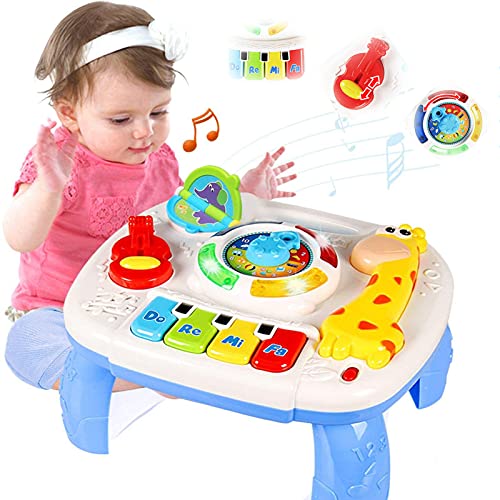
Your baby is discovering that their actions create sounds. Rattles, maracas, and simple shakers support this cause-and-effect learning while introducing rhythm and auditory discrimination. Choose instruments with a gentle, pleasant sound — loud or harsh toys can overwhelm sensitive ears. For electronic musical toys, look for models with volume control and simple, predictable responses. The best musical toys are those your baby can operate independently, without adult assistance.
4. Activity Cubes and Busy Boards
Activity cubes offer multiple mechanisms — spinning gears, sliding beads, flipping panels — that engage different fingers and build dexterity. They also encourage sustained attention as your baby moves from one activity to the next. Choose a cube with a stable, weighted base so it does not tip easily during enthusiastic play. Busy boards with buckles, zippers, and latches are excellent for slightly older babies and can be introduced now with supervision.
5. Soft Blocks and Early Building Toys
Soft, foam, or fabric blocks are ideal first building toys. They are safe for mouthing, easy to grasp, and forgiving when towers inevitably topple. Stacking two blocks is a major achievement at this age — celebrate it. As your baby's coordination improves, they will begin to stack higher and experiment with balance. Look for blocks with high-contrast patterns and varied textures to maintain interest.
6. Teething Toys
With teething often in full swing at eight months, dedicated teething toys are not optional — they are essential. Food-grade silicone teethers with textured surfaces provide safe relief and support oral motor development. Keep several in rotation, including one that can be chilled (not frozen solid) for extra comfort. Avoid teethers filled with liquid that could leak if punctured.
7. Board Books and Cloth Books
Language exposure is critical at this age, and books are the simplest way to build vocabulary and print awareness. Board books with thick pages are durable enough for enthusiastic page-turning, while cloth books are soft and safe for mouthing. Choose books with high-contrast images, simple faces, and repetitive text. Reading together also strengthens the caregiver-child bond, which is the most powerful developmental tool of all.
8. Interactive Electronic Toys (in Moderation)
Simple electronic toys — a light-up activity cube, a musical shape sorter, a talking rattle — can add variety and delight. The key is to prioritize toys where your baby is the active agent (pressing, turning, shaking) rather than a passive viewer. Avoid screen-based toys at this age. Electronic toys are best used as a supplement to open-ended play, not as the centerpiece of the toy collection.
How to Choose Toys for Your 8-Month-Old: A Practical Checklist
With thousands of options on the market, a structured approach makes selection far easier. Use the following criteria to evaluate any toy before bringing it home.
Safety First — Non-Negotiable
- No small parts: Anything that fits inside a toilet paper tube is a choking hazard. Avoid toys with buttons, beads, or detachable pieces smaller than this threshold.
- Non-toxic materials: Look for BPA-free, phthalate-free, and lead-free labels. Since babies mouth everything, material safety is paramount. You can also explore more non-toxic toy options as a reference point for safe material standards.
- No sharp edges or points: Run your fingers along all surfaces. Seams should be secure, and plastic edges should be rounded.
- Secure battery compartments: If the toy uses batteries, the compartment must require a screwdriver to open — never a simple snap latch.
- Age labeling: Toys labeled "6 months+" are appropriate. Toys labeled "3 years+" are not, even if they look simple.
Developmental Alignment
- Matches current ability: Your baby should be able to use the toy with minimal frustration. A toy that is too advanced causes frustration; one that is too simple causes boredom.
- Encourages active engagement: The best toys require your baby to do something — shake, stack, press, turn — rather than passively watch.
- Grows with your child: Stacking cups, soft blocks, and board books remain useful for many months, offering different challenges as skills develop.
Practical Considerations
- Easy to clean: Toys will be drooled on, dropped, and wiped. Look for surfaces that can be wiped with a damp cloth or are dishwasher-safe.
- Durable construction: Reinforced seams, solid builds, and high-grade materials mean the toy survives enthusiastic play and lasts through multiple children.
- Portable: A few small, lightweight toys that fit in a diaper bag make outings and travel far easier.
💡 Expert Tip: The Rotation Method
Instead of keeping every toy accessible at once, rotate your baby's toys every one to two weeks. Keep 8 to 12 toys out and store the rest. This simple practice renews novelty, deepens engagement, and prevents the overwhelm that comes with too many choices. It also extends the perceived value of your toy collection without adding anything new.
Toys to Avoid at 8 Months (and Why)
Just as important as knowing what to buy is knowing what to skip. The following categories are either unsafe, developmentally inappropriate, or simply ineffective at this age.
- Toys with small detachable parts: Choking risk. This includes button eyes on plush toys, removable wheels, and snap-together beads.
- Screen-based toys and tablets: The American Academy of Pediatrics recommends avoiding screen media for children under 18 months (except video chatting). Passive screen use displaces the active, hands-on play that drives development.
- Walkers with wheels: Sit-in walkers have been associated with injuries and are not recommended by child safety organizations. If you want to support pre-walking, choose a stationary activity center instead.
- Toys with long strings or cords: Strangulation risk. Avoid toys with cords longer than 12 inches.
- Loud electronic toys: Some toys exceed safe volume levels. If a toy sounds uncomfortably loud to you, it is too loud for your baby.
- Toys labeled for ages 3+: These often contain small parts and are not designed for mouthing. Wait until your child is developmentally ready.
Building a Balanced Toy Collection on a Sensible Budget
A well-curated collection of 8 to 12 toys is more effective than a cluttered room full of options. Focus on variety across categories rather than quantity within any single category. A balanced collection might include:
- One stacking or nesting set (essential tier)
- Two to three sensory balls or textured toys (essential tier)
- One or two musical rattles or shakers (balanced tier)
- One activity cube or busy board (balanced tier)
- One set of soft blocks (essential tier)
- Two to three teething toys (essential tier)
- Three to four board books (essential tier)
- One optional interactive electronic toy (premium tier)
This collection covers fine motor, sensory, cognitive, and language development without overwhelming your baby or your living space. As your child approaches their first birthday, you can introduce more complex toys — explore learning toys for 1-2 year olds to plan ahead. If you are also thinking about the next developmental stage, our guide to motor skill toys for 6 month olds provides useful context on how skills build progressively.
For families looking to expand their collection with high-quality options, it is worth exploring toys that are well-specified for their class — items that offer durable construction and thoughtful design without unnecessary complexity. The goal is not to own everything, but to own the right things.
Ready to Find the Perfect Toys for Your 8-Month-Old?
Browse our expert-selected recommendations below. Each toy has been evaluated for safety, developmental value, and real-world durability — so you can choose with confidence.
See Recommended Toys ↓Frequently Asked Questions
What types of toys are best for an 8 month old baby?
At 8 months, babies benefit most from toys that encourage sitting, reaching, grasping, and sensory exploration. Stacking cups, textured balls, sensory boards, and musical rattles are excellent choices. Look for toys that are safe to mouth, easy to grip, and promote cause-and-effect learning.
How many toys does an 8 month old really need?
An 8 month old does not need a large number of toys. A curated selection of 8 to 12 versatile, developmentally appropriate toys is sufficient. Rotating toys every week or two keeps engagement high and prevents overwhelm, which supports focused play and learning.
Are electronic toys good for 8 month olds?
Simple electronic toys with clear cause-and-effect responses, such as a musical rattle or a light-up activity cube, can be beneficial in moderation. However, passive screen-based toys should be limited. Open-ended, manually operated toys generally provide richer developmental value at this age.
What safety features should I look for in toys for an 8 month old?
Choose toys labeled for ages 6 months and up, with no small parts that could be choking hazards. Ensure there are no sharp edges, long strings, or loose batteries. Non-toxic, BPA-free materials are essential since babies at this age explore extensively with their mouths.
Should I introduce puzzles at 8 months?
Simple wooden peg puzzles with large, easy-to-grasp knobs can be introduced around 8 to 9 months, though your baby may initially just mouth or bang the pieces. The value comes from exposure — gradually, they learn that pieces fit into matching spaces. Keep the number of pieces low (three to five) and choose themes with familiar objects.
The Bottom Line
The must-have toys for an 8-month-old are not the most expensive or the most elaborate — they are the ones that match your baby's developmental stage, invite active exploration, and are safe for mouthing and manipulation. Focus on stacking toys, sensory balls, musical rattles, activity cubes, soft blocks, teething toys, and board books. Keep the collection small and rotate regularly. And remember: the most powerful toy in your baby's life is you. Your voice, your face, and your playful engagement amplify the value of every toy in the room.
For more age-specific guidance, explore our broader collection of must-have toys for 18 month olds to see how play evolves, or revisit the fundamentals with our must-have toys for 3 month olds guide to understand the developmental progression.