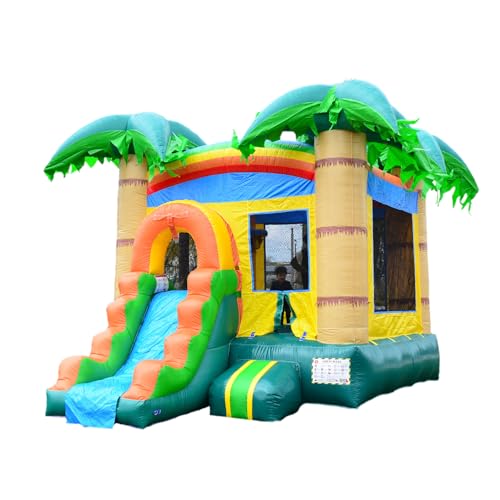
Commercial Bounce House with Water Slide: The Complete Buying Guide
Everything you need to choose a commercial-grade inflatable combo for rental businesses, schools, and event venues — from fabric denier and blower output to safety compliance and site preparation.
Explore Recommended Units🌊 Why a commercial combo unit matters: A commercial bounce house with water slide is a serious piece of event equipment. It must withstand repeated setups, heavy foot traffic, and constant moisture exposure. This guide walks you through the specifications, safety standards, and operational considerations that separate true commercial-grade inflatables from residential toys — so you can invest with confidence.
What Is a Commercial Bounce House with Water Slide?
A commercial bounce house with water slide is an inflatable play structure engineered for public, repeated use. Unlike a backyard bouncer, these units combine three functions in one footprint: a jumping chamber, a wet slide with a misting system, and often a splash pool at the base. They are the backbone of rental fleets, school carnivals, church festivals, and municipal summer programs.
The key distinction is construction. Commercial-grade inflatables use heavier fabrics — typically 18 oz PVC or 420D+ ripstop nylon with PVC coating — along with double or quadruple stitching, reinforced anchor points, and high-output blowers that maintain pressure under load. If you are comparing options, our guide to bounce houses with water slides and pools breaks down the configuration differences, while the blower-included bundle guide explains why the blower is not a component to overlook.
For operators scaling a rental business, the bounce house and water slides for sale overview provides a wider market context. And if you are weighing a commercial unit against a residential one, the commercial water slide bounce house for sale guide dives into the specific upgrades that justify the commercial tier.
Key Features That Define a Commercial-Grade Unit
Reinforced Fabric & Stitching
Commercial units use heavier denier fabrics with double-stitched and quadruple-stitched seams at stress points. This is the single biggest durability differentiator versus residential inflatables.
High-Output Blower System
A commercial blower maintains constant pressure even when multiple jumpers are active. Look for blowers rated for continuous duty and compatible with the unit's cubic footage.
Safety Anchoring & Tie-Downs
Commercial units ship with a full anchor kit — ground stakes, sandbags, or both. Proper anchoring is non-negotiable for outdoor deployment, especially in windy conditions.
Non-Slip Climbing & Slide Surfaces
Wet surfaces demand textured climbing walls and slide lanes. Commercial-grade units incorporate non-slip materials that remain grippy when soaked.
Splash Pool Integration
Many combo units include a built-in splash pool at the slide exit. This adds play value but also requires proper drainage planning at the venue.
Compliance Documentation
Reputable manufacturers provide safety compliance documentation, operating manuals, and material safety data. This matters for insurance and permits.
Commercial Inflatable Tiers: A Relative Comparison
The commercial inflatable market segments into distinct quality tiers. Rather than focusing on numbers, understand where each tier sits relative to the others in construction quality, intended usage frequency, and operational lifespan.
| Tier | Best For | Construction Profile |
|---|---|---|
| Entry-Level Commercial | Occasional events, small rental fleets | Heavier fabric than residential, single-stitched stress points, standard blower |
| Mid-Range Commercial | Active rental businesses, school programs | Double-stitched seams, reinforced anchor points, continuous-duty blower |
| High-End Commercial | High-volume rental operators, municipal contracts | Quadruple-stitched stress points, commercial-grade PVC, high-output blower system |
| Professional-Grade / Commercial-Grade | Permanent venues, large-scale events | Premium materials, full compliance documentation, engineered for daily deployment |
Mid-range units typically offer a meaningful step up in seam construction and blower reliability compared to entry-level models, while high-end tiers add the material thickness and documentation that insurance carriers and municipalities increasingly request. For operators exploring the broader commercial inflatable water slide category, the commercial inflatable water slides hub provides additional comparison context.
Pre-Purchase Checklist for Commercial Buyers
Before you commit to a unit, verify these points:
- Footprint and clearance: Confirm the inflated dimensions plus the manufacturer-specified safety clearance on all sides.
- Power requirements: Most commercial blowers need a dedicated circuit. Check amperage and whether a generator is viable for remote venues.
- Water supply and drainage: Plan for a reliable water source and a drainage path for the splash pool overflow.
- Anchor kit completeness: Confirm the unit ships with stakes, sandbags, or both, and that the anchor points are reinforced.
- Compliance documentation: Request safety compliance certificates and operating manuals before purchase.
- Insurance eligibility: Verify that your insurer accepts the unit's compliance documentation.
- Local permits: Check municipal or county requirements for inflatable amusement devices at public events.
- Repair kit and spare parts: A commercial unit should ship with a patch kit and accessible replacement blower parts.
Setup, Operation, and Maintenance Essentials
Proper setup is where most inflatable incidents originate. A commercial bounce house with water slide must be deployed on level ground, free of sharp objects and debris. The blower should be positioned on a dry surface, protected from splash zone, and connected to a dedicated circuit. Anchor the unit before inflation and re-check anchors after the structure is fully pressurized.
During operation, monitor the number of simultaneous users against the manufacturer's capacity rating, enforce a no-shoes and no-food policy on the inflatable surfaces, and keep a trained attendant at the entry point at all times. For wet operation, maintain a consistent misting level — over-saturation creates slippery climbing surfaces, while under-saturation defeats the purpose of the water slide feature.
After each event, drain the splash pool, wipe down wet surfaces, and allow the unit to air-dry completely before folding. Moisture trapped in folded PVC is the leading cause of mildew and seam degradation. For broader inflatable water slide buying context, the commercial inflatable water slide with pool guide covers pool-integrated configurations in more depth, and the entry-tier commercial inflatable overview is useful if you are building a starter fleet.
Adjacent Considerations for Event Operators
If your event portfolio includes both dry and wet attractions, the bounce house with water slide and air blower bundle is worth reviewing for its packaging details. For adult-oriented events, the adult-capacity bounce house with water slide guide explains the structural upgrades required. And if you are comparing rental versus purchase, the blow-up water slide rental overview provides a useful counterpoint to ownership.
Operators serving schools and community centers may also want to review the commercial playground equipment for schools guide for complementary permanent installations, and the children's indoor bounce house guide for weather-contingency options. If your venue hosts mixed-age crowds, the bounce house with ball pit and slide configuration offers an alternative play format worth comparing.
Frequently Asked Questions
What is a commercial bounce house with water slide?
A commercial bounce house with water slide is a heavy-duty inflatable play structure designed for repeated public use, combining a jumping area with a wet slide and often a splash pool. These units are built with reinforced materials, commercial-grade blowers, and safety features that meet stricter standards than residential inflatables.
How is a commercial inflatable different from a residential one?
Commercial units use heavier denier fabrics, double and quadruple stitching, reinforced anchor points, and higher-output blowers. They are engineered for frequent setup and takedown, larger crowds, and stricter safety compliance, making them suitable for rental businesses, schools, and event venues.
What space and power requirements does a commercial water slide bounce house need?
Most commercial combo units require a flat area significantly larger than the inflated footprint for safety clearance, a dedicated power circuit for the blower, and a reliable water supply with drainage. Always follow the manufacturer's specified footprint, clearance, and electrical requirements.
What safety standards should I look for?
Look for units that comply with recognized inflatable safety standards, include anchor points and tie-down kits, feature non-slip climbing surfaces, and come with clear operating manuals. Verify insurance eligibility and local permit requirements before purchase.
Ready to Compare Commercial Units?
Browse our curated selection of commercial-grade bounce houses with water slides, selected for construction quality, safety documentation, and operational reliability.
View Recommended Units