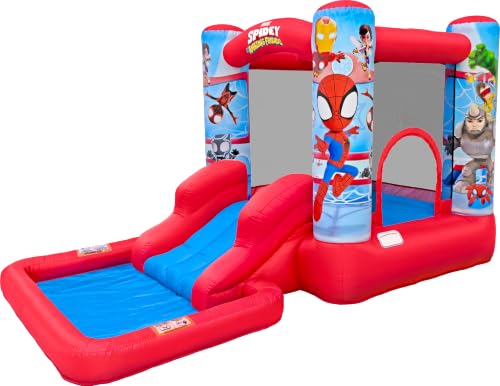
Bounce House with Water Slide and Pool: The Complete Buyer's Guide
Everything you need to know before choosing a backyard water park — from safety features and inflation systems to splash-pool depth, slide design, and long-term durability. Compare entry-level, mid-range, and top-tier options with confidence.
Explore Buying Guide ↓What Is a Bounce House with Water Slide and Pool?
A bounce house with water slide and pool is an inflatable play structure that combines three distinct zones in a single unit: a jumping area, a sloped water slide, and a splash pool at the base. A continuous-flow electric blower keeps the structure inflated, while a standard garden hose connects to a misting or soaking system along the slide and pool walls.
These hybrid inflatables have become the centerpiece of backyard summer entertainment because they deliver the thrill of a water park without leaving home. When the hose is disconnected, the same unit functions as a dry bounce house and slide, making it a versatile year-round investment for active children.
The category spans a wide range of designs — from compact starter-tier models with a short slide and shallow splash pool to premium and commercial-grade inflatables with reinforced climbing walls, deeper pools, and high-capacity blowers. Understanding how these tiers differ is the foundation of a smart purchase.
Why Families Choose a Bounce House with Water Slide and Pool
Parents researching this product category usually have one goal: keeping kids active, cool, and entertained during warm months without a daily trip to a public pool. A combined bounce house and water slide delivers several practical benefits:
- One structure, multiple activities. Jumping, sliding, and splashing happen in a single footprint, which reduces the number of separate inflatables or water toys cluttering the yard.
- Adjustable wet and dry play. The same unit works as a dry slide and jumper when the weather cools, extending its usable lifespan across seasons.
- Social play value. A splash pool and wide slide encourage cooperative play, turn-taking, and active group games — a strong alternative to screen time.
- Event-ready. These inflatables are popular for birthday parties, family reunions, and neighborhood gatherings. Many families also explore rental-oriented models when hosting larger events.
If you are planning a bigger celebration or a community event, it helps to understand how commercial inflatables differ from residential ones. Our guide to commercial bounce house with water slide options explains capacity, blower requirements, and safety compliance in more detail.
Key Features That Matter
Not all inflatables are built to the same standard. The features below separate a reliable long-term purchase from a unit that may struggle after a single season.
1. Slide Design and Height
Slide length and slope angle determine both fun factor and safety. Entry-level models typically feature a shorter, gentler slide suitable for younger children. Mid-range and top-tier units often include a taller slide with reinforced side walls and a non-slip climbing ladder or ramp. A slide that ends directly into the splash pool creates the most seamless water-play experience.
2. Splash Pool Depth and Drainage
The integrated pool should be deep enough for splashing but shallow enough to remain safe for young children under supervision. Look for a pool with a quick-release drain valve — this makes emptying and drying significantly easier and helps prevent stagnant water and mildew.
3. Inflation and Blower System
A continuous-flow blower keeps the structure firm. Higher-tier models pair a more powerful blower with a GFCI-protected plug for electrical safety near water. Heavy-duty blowers inflate faster and maintain pressure more consistently, especially when multiple children are jumping.
4. Safety Netting and Entry Ramp
Reinforced netting around the jumping zone prevents falls, while a safety ramp or non-slip entry mat reduces the risk of slips at the entrance. Mesh windows improve visibility for supervising adults.
5. Anchoring and Ground Stakes
Every inflatable must be secured with ground stakes or sandbags. Wind can lift even a partially inflated unit, so staking is non-negotiable. Premium models often include reinforced anchor points and a stake kit designed for the unit's inflated size.
6. Material and Stitching Quality
Heavy-duty, puncture-resistant material with double-stitched seams and reinforced stress points is the hallmark of a durable inflatable. Commercial-grade units use thicker material and industrial stitching for frequent use; residential top-tier models sit just below that threshold.
Safety Standards and Supervision
Water and inflatables are a fun combination, but they demand strict safety practices. Before the first use, review the following checklist:
- Adult supervision at all times. Never allow children to use the water slide or splash pool without a responsible adult actively watching.
- Respect age and weight limits. Most residential units are designed for children aged 3 and older, with per-user limits typically between 100 and 120 pounds. Group children of similar size together.
- One at a time on the slide. Enforce a single-file rule on the slide and a clear landing zone in the pool to prevent collisions.
- Electrical safety. Plug the blower into a GFCI-protected outlet and keep cords away from water and walking paths. Never operate the blower with wet hands.
- Secure anchoring. Stake the unit fully before inflation and check stakes periodically during use.
- Weather awareness. Do not use the inflatable during high winds, thunderstorms, or lightning. Deflate and store the unit when not in use.
For families who want to compare safety features across larger, event-oriented inflatables, our detailed look at commercial water slide bounce house for sale options covers compliance standards, capacity, and reinforced safety design.
Setup and Space Requirements
Proper setup is the difference between a safe, stable play structure and a frustrating afternoon. Follow these practical guidelines:
- Choose a flat, level surface. Grass or a padded surface is ideal. Avoid concrete, gravel, and slopes, which increase slip and tip-over risks.
- Clear the area. Remove rocks, sticks, toys, and debris. Allow at least 3 to 5 feet of clearance on all sides beyond the inflated dimensions for safe entry and exit.
- Inflate with the blower. Most electric blowers fully inflate a residential unit in 2 to 5 minutes. Keep the blower running continuously during use.
- Stake and secure. Drive ground stakes into all anchor points before children enter. Sandbags can supplement stakes on hard surfaces.
- Connect the water system. Attach a standard garden hose to the designated connection point. Adjust the flow to a light mist for younger children or a steady stream for older kids.
- Fill the splash pool. Allow the pool to fill to the recommended level, then monitor water depth throughout play.
For a broader comparison of inflatable configurations — including slide-only and pool-only designs — see our overview of blow-up water slide with pool models.
Maintenance and Storage Tips
A well-maintained inflatable can last many seasons. Build these habits into your routine:
- Dry completely before storage. Empty the pool, disconnect the hose, and let the unit air-dry fully to prevent mold and mildew. A dry, sunny afternoon is ideal.
- Clean with mild soap. Wipe down surfaces with a gentle soap-and-water solution. Avoid harsh chemicals that can degrade the material.
- Inspect seams and stitching. Check stress points, anchor loops, and seams after each use. Repair small punctures promptly with the included patch kit.
- Store folded and covered. Store the deflated unit in a dry, covered location away from direct sunlight. Keep the blower and stakes together for easy setup next time.
- Rotate play zones. If your yard allows, move the inflatable periodically to prevent wear on the same patch of grass.
For families weighing different inflatable categories, our guide on bounce house and water slides for sale compares configuration options and what to look for in each style.
Tier Comparison and Buying Guide
The market for bounce houses with water slides and pools can be organized into three broad tiers. Use this comparison to match a unit to your family's expected frequency of use, number of children, and storage space.
| Tier | Best For | Typical Slide & Pool Design | Blower & Material | Durability Outlook |
|---|---|---|---|---|
| Entry-level | Occasional weekend use, 1–2 younger children | Shorter slide, shallow splash pool, compact footprint | Standard blower, lighter-weight material, single-stitched seams | Good for light seasonal use; expect to upgrade as children grow |
| Mid-range | Regular summer use, 2–4 children, birthday parties | Taller slide with reinforced walls, deeper pool with drain valve | Stronger continuous-flow blower, puncture-resistant material, double-stitched seams | Solid multi-season performance; balanced tier for most families |
| Top-tier | Frequent use, large families, neighborhood events | Full-height slide, climbing wall, deep splash pool, shaded slide area | Heavy-duty blower with GFCI plug, commercial-grade material, reinforced anchor points | Long-term investment; closest residential equivalent to commercial build |
As a general rule, mid-range models offer the best balance for typical families: the blower is noticeably smoother and more consistent than entry-level units, the slide and pool are sized for growing children, and the material withstands regular summer use. Top-tier units are worthwhile for households that host frequent gatherings or live in hot climates where the inflatable sees near-daily use.
Frequently Asked Questions
What age is a bounce house with water slide and pool suitable for?
Most residential models are designed for children aged 3 and up, with a per-user weight limit typically between 100 and 120 pounds. Always verify the manufacturer's age recommendation and weight capacity, and supervise children at all times.
How much space do I need?
You need a flat, cleared area that exceeds the inflated dimensions by at least 3 to 5 feet on every side. A typical mid-range unit inflates to roughly 15 to 20 feet in length, so a backyard of at least 25 by 25 feet is a practical minimum.
How long does setup take?
Inflation with an electric blower takes 2 to 5 minutes. Staking, connecting the hose, and filling the splash pool add about 10 to 15 minutes, for a total setup time of roughly 20 minutes.
Can it be used without water?
Yes. Disconnect the hose and the unit functions as a standard dry bounce house and slide. This makes it useful across seasons, not just in summer.
What safety features should I prioritize?
Look for reinforced netting, a non-slip entry ramp, ground stakes or sandbags, and a blower with a GFCI plug. A covered slide area and a splash pool with a drain valve are valuable additions for safe, convenient use.
How do I prevent mold and mildew?
Empty the pool and let the inflatable air-dry completely before folding and storing. Store it in a dry, covered location, and wipe surfaces with mild soap between uses.