Backyard Playsets: The Complete Guide to Choosing the Right Outdoor Play System
Transform your outdoor space into a world of adventure, exercise, and imagination. This in-depth guide covers everything you need to know about selecting a safe, durable, and age-appropriate backyard playset for your family.
Explore the Buying Guide🌳 Why a Backyard Playset Matters: A well-chosen playset is more than just outdoor equipment — it's a catalyst for physical development, social interaction, and creative free play. Unlike screen-based entertainment, a playset encourages children to climb, swing, slide, and imagine, building strength, coordination, and confidence in the fresh air. This guide walks you through the key considerations so you can make an informed decision with confidence.
Why a Backyard Playset Is a Worthwhile Investment
Parents researching outdoor play equipment are typically looking for a long-term addition to the family home — something that will grow with their children and provide years of active enjoyment. A quality playset delivers on multiple fronts:
- Physical development: Climbing, swinging, and sliding build gross motor skills, balance, and core strength. These activities are essential for healthy childhood development and complement the skills children develop through educational toys and indoor learning.
- Social skills: Playsets naturally become a gathering point for friends and siblings, encouraging cooperative play, turn-taking, and negotiation.
- Imaginative play: Forts, towers, and play decks become pirate ships, castles, or secret hideouts — fueling creativity in ways that structured toys sometimes cannot.
- Screen-free engagement: A playset provides an inviting alternative to indoor screens, promoting healthy outdoor habits from an early age.
- Long-term value: A well-built playset is a long-term investment that can serve multiple children and adapt as they grow.
If you're also considering smaller outdoor additions, our guides on backyard toys for preschoolers and outdoor toys can help you build a complete outdoor play environment.
Types of Backyard Playsets: Finding the Right Fit
Backyard playsets come in several configurations, each suited to different spaces, ages, and family needs. Understanding the main categories will help you narrow down your options quickly.
Wooden Playsets
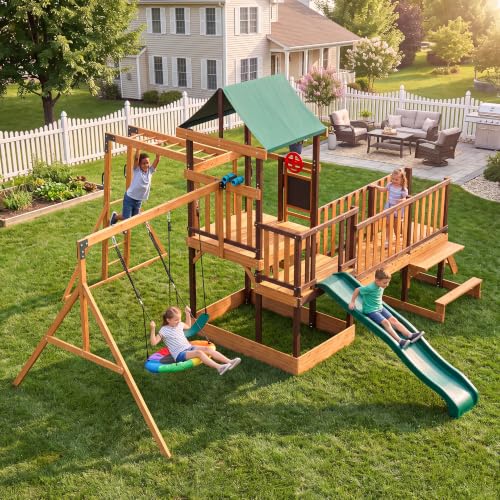
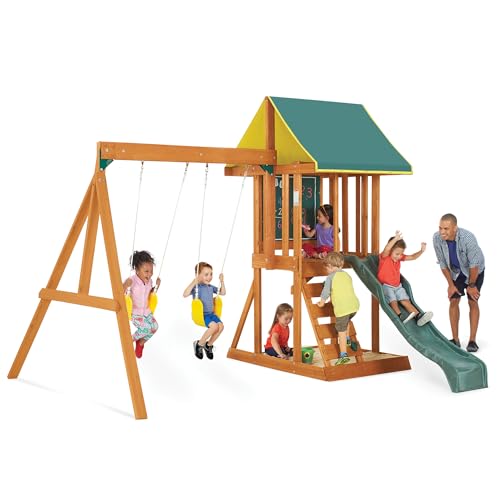
Wooden playsets are the traditional choice for families seeking a natural aesthetic and robust construction. High-quality wooden sets use cedar or redwood, which naturally resist rot and insects. These sets often include swing beams, climbing walls, slides, and elevated play decks. Wooden playsets are generally considered the most durable category and can be refinished over time, extending their lifespan significantly. They blend well with garden landscapes and offer a timeless appeal.
Metal Playsets
Metal playsets — typically constructed from powder-coated steel — are known for their strength and low maintenance. They resist rust when properly coated and are often lighter than wooden equivalents, making relocation easier. Metal swing sets are particularly popular for their smooth swinging motion. Many mid-range and premium metal sets include integrated slides and climbing features.
Plastic and Resin Playsets
Plastic playsets are the most common choice for younger children, particularly toddlers. They are lightweight, weather-resistant, and typically feature rounded edges for safety. These sets often include small slides, climbing steps, and play panels. While plastic sets are generally entry-level in terms of structural complexity, they are an excellent starter option for families with very young children. For age-specific recommendations, see our guide on age-appropriate toys.
All-in-One Play Systems
For families who want a comprehensive solution, all-in-one play systems combine swings, slides, climbing structures, and play decks into a single integrated unit. These systems are ideal for maximizing play value in a compact footprint and often include modular components that can be rearranged or expanded over time.
Playset Tiers: Entry-Level, Mid-Range, and Premium
To help you compare playsets without focusing on transient market pricing, we use a universal tier classification system. This reflects the relative position of each product within its category, focusing on construction quality, feature set, and intended lifespan.
Starter Tier
Best suited to toddlers and younger children, entry-level playsets typically feature simpler construction, fewer accessories, and a compact footprint. They are an excellent introduction to outdoor play and work well for families testing the waters before committing to a larger system. Expect basic swing and slide configurations with straightforward assembly.
Balanced Tier
The most popular category for growing families. Mid-range playsets offer a solid balance of durability, play features, and structural complexity. They often include climbing walls, elevated towers, and multiple swing positions. Construction materials are more robust, and the design accommodates children across a wider age range.
Top-Tier
Premium playsets represent the flagship tier of the category. They feature heavy-duty construction, premium materials, extensive play features, and modular expandability. These sets are designed for large families and are built to remain in place for many years. Expect commercial-grade hardware, reinforced joints, and weather-resistant finishes.
| Feature | Entry-Level | Mid-Range | Premium |
|---|---|---|---|
| Best For | Toddlers, smaller yards | Growing families, multi-age use | Large families, long-term installation |
| Material Quality | Basic plastic or light wood | Solid wood or powder-coated steel | Premium cedar, heavy-gauge steel, composite |
| Play Features | Basic swing and slide | Swings, slide, climbing wall, play deck | Full multi-level system with tower, fort, accessories |
| Assembly Complexity | Low to moderate | Moderate | Moderate to high (professional install recommended) |
| Lifespan | Several years | Many years with maintenance | Decade or more with proper care |
| Expandability | Limited | Moderate | High (modular add-ons available) |
⚠️ Playset Safety Checklist
- Age recommendations: Always follow the manufacturer's age guidelines. Playsets designed for ages 3–10 are not suitable for toddlers under 3 without supervision and appropriate adaptations.
- Surface safety: Install playsets over impact-absorbing surfaces such as wood chips, rubber mulch, or sand. Avoid concrete, asphalt, or packed earth beneath swings and slides.
- Clearance zones: Maintain a minimum of 6 feet of clear space around the entire structure, and at least twice the height of the swing beam in front and behind the swings.
- Anchor securely: Ground anchors are essential for stability, especially in windy areas. Most manufacturers provide anchor kits; use them.
- Regular inspection: Check bolts, chains, and connections monthly. Look for wear on swing seats, rust on metal components, and splintering on wooden parts.
- Supervision: Young children should always be supervised during play. Establish clear rules about safe use — no pushing, no walking behind swings, and no climbing on the outside of the structure.
For a broader look at toy safety, read our comprehensive Toy Safety Guide and learn about choking hazard prevention.
How to Choose a Backyard Playset: A Step-by-Step Buying Guide
With the right preparation, selecting a playset can be a straightforward process. Follow these steps to ensure you choose a system that fits your space, your children, and your long-term needs.
Step 1: Assess Your Space
Measure your available yard space carefully. Remember to account for the safety clearance zones around swings and slides. A playset that looks compact on paper may require significantly more space once installed. Consider the slope of your yard — a level surface is essential for stability and safety. If your space is limited, a compact backyard toy or a smaller climbing frame may be a better fit.
Step 2: Consider Your Children's Ages
A playset that suits a 2-year-old will not challenge a 9-year-old. If you have children of different ages, look for modular systems that can accommodate multiple age groups simultaneously — for example, a baby swing alongside a standard swing, or a lower climbing wall alongside a taller one. Our guides on toys for 1–2 year olds and toys for 5 year olds can help you align your playset choice with developmental stages.
Step 3: Choose Your Material
Wood, metal, and plastic each have distinct advantages. Wood offers a natural look and excellent durability but requires periodic maintenance. Metal is low-maintenance and strong but can become hot in direct sunlight. Plastic is lightweight and weather-resistant but generally less structurally robust for larger configurations. Consider your climate and maintenance preferences when making this choice.
Step 4: Evaluate Construction Quality
Look for reinforced joints, heavy-duty hardware, and weather-resistant coatings. Thicker wood beams and powder-coated steel indicate higher quality. Check customer reviews for mentions of durability and assembly experience. A playset with solid construction may sit in the premium tier, but it represents a long-term investment that will serve your family for years.
Step 5: Plan for Installation
Some playsets require professional installation, while others are designed for DIY assembly. Factor in the time and tools required. If you choose a premium, multi-level system, professional installation is often recommended to ensure structural integrity and safety. For smaller sets, a weekend DIY project is entirely feasible.
Step 6: Consider Add-Ons and Accessories
Many playsets support accessories such as swing set accessories, climbing walls, and play panels. If you plan to expand in the future, choose a system with modular compatibility. Accessories can refresh the play experience as your children grow, extending the playset's useful life.
For families considering broader outdoor entertainment options, you may also be interested in backyard obstacle courses and backyard inflatable water slides for warm-weather fun.
Age-by-Age Playset Recommendations
Children at different developmental stages have different needs, abilities, and safety requirements. Here's a quick breakdown to help you match a playset to your child's age.
Toddlers (Ages 1–3)
At this stage, safety and accessibility are paramount. Look for low-to-the-ground structures with gentle slides, rounded edges, and enclosed play areas. Small plastic or resin playsets with built-in steps and short slides are ideal. Avoid high platforms or complex climbing structures. For more specific guidance, see our articles on toys for 18 month olds and toys for 2 year olds.
Preschoolers (Ages 3–5)
Preschoolers are ready for more adventurous play. Playsets with small climbing walls, slightly taller slides, and swing sets become appropriate. Look for sets that include play panels or sandbox attachments to encourage imaginative play. Our backyard toys for preschoolers guide offers additional ideas for this age group.
School-Age Children (Ages 6–10)
This is the golden age for playsets. Children can handle taller climbing structures, higher swings, and more complex configurations. Mid-range and premium playsets with multi-level play decks, monkey bars, and rope ladders are excellent choices. The playset becomes a social hub for friends and a platform for increasingly sophisticated imaginative games.
If your child is transitioning from toddler to school age, our guide on age-appropriate toys for 5 year olds can help you plan a smooth progression of play experiences.
Maintaining Your Backyard Playset
Proper maintenance ensures your playset remains safe and functional for years. The level of maintenance required depends largely on the material:
- Wooden playsets: Inspect annually for splinters, rot, and loose hardware. Apply a water-repellent stain or sealant every one to two years to protect against moisture and UV damage.
- Metal playsets: Check for rust spots and touch up with rust-inhibiting paint as needed. Tighten bolts and inspect swing chains for wear.
- Plastic playsets: Clean with mild soap and water. Check for cracks or fading, particularly in areas exposed to direct sunlight.
Regular maintenance not only extends the lifespan of your playset but also ensures a safe play environment for your children. For more general tips on toy care, see our toy longevity tips.
Frequently Asked Questions About Backyard Playsets
Most standard backyard playsets are designed for children aged 3 to 10. However, many families introduce a playset when their child is around 2–3 years old and choose a modular system that can be adapted as the child grows. Always follow the manufacturer's age recommendations, and consider a starter-tier set for younger children before upgrading to a larger system.
Not necessarily. Entry-level and mid-range playsets are typically designed for DIY assembly with standard household tools. Premium, multi-level systems may benefit from professional installation to ensure structural integrity and proper anchoring. Always read the assembly instructions carefully and follow all safety guidelines.
Space requirements vary by configuration, but a general guideline is to maintain at least 6 feet of clear space on all sides of the playset, and at least twice the height of the swing beam in front and behind the swings. Measure your available yard space carefully and check the manufacturer's specifications before purchasing.
Impact-absorbing surfaces such as wood chips, rubber mulch, sand, or pea gravel are recommended. Avoid installing a playset over concrete, asphalt, or packed earth. The depth of the surfacing material should be appropriate for the height of the play structure — taller structures require deeper surfacing.
Many playsets can be disassembled and relocated, though this is easier with metal and plastic sets than with large wooden structures. If you anticipate moving in the near future, consider a playset that is designed for relatively straightforward disassembly and reassembly, or opt for a smaller, lighter configuration.
Winter care depends on your climate and the playset material. For wooden sets, ensure the structure is sealed before winter to protect against moisture. Remove or secure swing seats and other removable accessories during heavy storms. Inspect the playset thoroughly in spring for any winter damage before resuming use.
Ready to Create Your Backyard Adventure?
Now that you understand the key factors — material, tier, safety, and age-appropriateness — you're equipped to choose a playset that will bring years of joy to your family. Browse our curated selection of recommended playsets below to find the perfect fit for your outdoor space.
View Recommended Playsets📚 Continue Exploring: For more ideas on building an active, engaging backyard environment, browse our guides on backyard toys for preschoolers, backyard obstacle courses, and backyard water slides for warm-weather fun.