
Playground Sets for Backyards: The Complete Guide to Choosing the Right Outdoor Playset
Transform your backyard into a world of adventure, exercise, and imagination. This comprehensive guide walks you through everything you need to know about selecting, installing, and maintaining a playground set that fits your family's space, safety needs, and lifestyle.
Explore Top PicksWhy a Backyard Playground Set Is a Worthwhile Investment
A backyard playground set does more than fill an empty corner of your yard. It creates a dedicated space for children to develop physical strength, coordination, and social skills through unstructured play. Research consistently shows that outdoor play supports cognitive development, reduces screen time, and builds confidence. For families with multiple children, a playset offers a shared activity that grows with them—from toddler swings to climbing walls and slides.
Choosing the right set, however, involves more than pointing at a catalog. You need to consider your available space, your children's ages and abilities, the materials that will withstand your climate, and the safety features that protect against falls and injuries. This guide breaks down each factor so you can make an informed decision with confidence.
Quick Insight: A well-chosen playground set can serve a family for 8–10 years or more. The key is matching the structure's features and durability to your children's current and future needs, rather than shopping by a single feature or appearance.
Types of Backyard Playground Sets: Finding Your Match
The market offers several distinct categories of outdoor playsets, each suited to different spaces and play styles. Understanding these categories helps you narrow down your search before diving into specific models.
Wooden Playsets
Wooden playground sets remain the most popular choice for backyards. Constructed from cedar, redwood, or pressure-treated pine, these sets offer a natural aesthetic that blends into garden landscapes. High-quality wooden sets feature reinforced joints, weather-resistant finishes, and modular designs that allow you to add components later. They tend to be heavy and sturdy, which reduces sway during active play. For families planning long-term use, a premium wooden set from a reputable manufacturer represents a solid long-term investment.
Metal Playsets
Metal swing sets and climbing frames are lighter and often easier to assemble than wooden alternatives. Galvanized steel construction with rust-proof finishes can last for many years, particularly in dry climates. Metal sets typically excel at swinging and sliding but may offer fewer climbing or fort-building options. They are a strong choice for families who prioritize swing height and smooth motion.
Plastic and Resin Playsets
Plastic playsets are the lightest option and are often designed for younger children. They are easy to move, require minimal maintenance, and resist rot and insects. However, they may become brittle in extreme heat or cold, and their lighter weight can make them less stable during vigorous play. These sets are best suited for toddlers and preschoolers who need a safe, enclosed play space close to the house.
Multi-Feature and Modular Systems
For families who want a one-stop play destination, modular playground systems combine swings, slides, climbing walls, monkey bars, and play decks into a single structure. These sets are feature-rich for their class and can be expanded with add-on components. They require more space and a more involved installation process, but they deliver the most varied play experience.
Space Tip: If your yard is compact, explore playground equipment for small backyards to find space-efficient configurations that still deliver a full range of play activities.
Comparing Playground Set Tiers: Entry-Level to Premium
Playground sets fall into distinct tiers based on construction quality, feature depth, and intended lifespan. The table below outlines what to expect from each tier so you can align your expectations with your family's needs.
| Tier | Best For | Construction & Materials | Typical Features | Lifespan Expectation |
|---|---|---|---|---|
| Starter Tier | Young families with toddlers or preschoolers; smaller yards | Lighter wood or resin; basic hardware; simplified assembly | Toddler swing, short slide, small play deck | 3–5 years with proper care |
| Mid-Tier | Families with children aged 3–8; standard suburban yards | Solid wood or galvanized steel; reinforced joints; weather-resistant coating | Two swings, slide, climbing wall, play deck with canopy | 5–8 years |
| High-End Tier | Growing families; larger yards; long-term use | Premium cedar or redwood; heavy-duty brackets; rust-proof hardware | Multiple swings, tube slide, monkey bars, upper deck, sandbox | 8–12 years |
| Flagship Tier | Large families or those seeking a permanent play destination | Commercial-grade lumber; professional-grade fasteners; multi-layer weather protection | Full play tower, dual slides, climbing net, swing bay, picnic table | 12+ years with maintenance |
When comparing tiers, keep in mind that mid-tier models typically offer a smoother swing motion and more stable climbing surfaces than entry-level sets, while flagship-tier structures often include reinforced platforms that comfortably support multiple children at once. The right choice depends on how intensively the set will be used and how long you plan to keep it.
Key Features to Evaluate Before You Buy
Not all playground sets are created equal. Beyond the basic swing-and-slide combination, several features significantly affect safety, play value, and longevity.
Slide Design and Height
Slides come in straight, curved, and tube configurations. Straight slides are the most common and easiest to supervise. Curved slides add a gentle thrill for older children. Tube slides enclose the rider and are popular in high-end sets but can become hot in direct sunlight. Pay attention to slide height relative to your child's age—a 4-foot slide is appropriate for preschoolers, while school-age children enjoy 6- to 8-foot slides.
Swing Types and Capacity
Most sets include two or three swing positions. Belt swings are standard for school-age children, while full-bucket swings with leg holes support toddlers and babies. Some sets offer a glider or trapeze bar as a third position. Consider whether the frame can accommodate future additions, such as a toddler swing when a younger sibling arrives.
Climbing Structures
Climbing walls with handholds and footholds build strength and coordination. Look for climbing walls with a gentle slope for younger children and steeper angles for older kids. Monkey bars and climbing nets add upper-body challenge but require adequate clearance and soft surfacing beneath.
Play Deck and Canopy
An elevated play deck provides a shaded retreat and a platform for imaginative play. Canopies and roofs protect children from sun exposure and extend the set's usable hours. A sandbox or lower play area beneath the deck adds another layer of engagement.
Hardware and Fasteners
Stainless steel or galvanized hardware resists rust and corrosion. Check that bolts are recessed or capped to prevent snagging. Reinforced brackets at joint intersections are a hallmark of durable construction.
Pre-Purchase Checklist
- Measure your yard and confirm clearance of at least 6 feet on all sides
- Verify the set's age recommendation matches your child's stage
- Check the weight capacity per swing and per platform
- Confirm the materials are weather-resistant for your climate
- Review assembly requirements and whether professional installation is offered
- Plan for safety surfacing beneath and around the structure
- Check warranty terms on lumber, hardware, and components
Safety First: Surfacing, Spacing, and Supervision
Safety is the single most important consideration when installing a playground set. Falls are the leading cause of playground-related injuries, and proper surfacing dramatically reduces impact severity. The surface beneath and around the set should extend at least 6 feet in all directions—and 6 feet in front of and behind swings—and should be deep enough to absorb impact.
Common safety surfacing options include rubber mulch, engineered wood fiber, sand, pea gravel, and poured-in-place rubber. Rubber products generally offer the best shock absorption and longevity, though they require a higher upfront outlay. Loose-fill materials like wood chips and sand are effective but need periodic replenishment and raking. For a deeper dive into surfacing specifications, consult this guide to playground safety surfacing.
Beyond surfacing, ensure the set is level and anchored according to the manufacturer's instructions. Anchor kits are essential for wooden and metal sets, particularly in areas with high winds. Regularly inspect bolts, swing chains, and slide connections for wear. Supervise young children at all times, and establish clear rules about safe play—no pushing, no walking in front of moving swings, and no climbing on the outside of the structure.
Age-Appropriate Safety: Toddlers and preschoolers need enclosed platforms, full-bucket swings, and shorter slides. School-age children can handle climbing walls and belt swings. If you have children at different ages, look for sets with separate zones or plan to add components as your children grow. Explore playground equipment for 2-5 year olds and equipment for 5 year olds for age-specific guidance.
Installation, Maintenance, and Longevity Tips
Proper installation sets the foundation for years of safe play. Many manufacturers offer detailed instructions and pre-drilled components that simplify assembly. For larger sets, professional installation is a worthwhile investment—it ensures the structure is level, anchored, and assembled correctly, which protects your warranty and your children's safety.
Maintenance requirements vary by material. Wooden sets benefit from annual inspections, tightening of bolts, and reapplication of sealant or stain every one to two years. Metal sets require occasional cleaning and touch-up of any rust spots. Plastic components should be checked for cracks or fading. Swings, chains, and slides should be inspected monthly for wear and replaced as needed.
Winter care matters too. If you live in an area with freezing temperatures, consider covering or storing removable components like canopies and swings. Check the base of the set for frost heave in spring and re-level if necessary. With consistent care, a quality playground set can remain a backyard centerpiece for a decade or more.
Matching Playground Sets to Your Child's Age
Children's physical abilities and play interests change rapidly. A set that suits a 3-year-old will not challenge a 7-year-old, and a structure designed for a 10-year-old may be unsafe for a toddler. Use these age-band guidelines to narrow your options:
For Toddlers and Preschoolers (Ages 2–5)
Prioritize low platforms, full-bucket swings, short slides, and enclosed play areas. Look for sets with rounded edges, easy-grip handles, and stable bases. A playhouse or lower deck with a small slide is often ideal. For more detailed recommendations, see playground equipment for 3-5 year olds.
For School-Age Children (Ages 5–8)
This age group enjoys climbing walls, belt swings, monkey bars, and slides with a bit of height. Sets with a play deck, canopy, and multiple swing positions offer variety and room to grow. Browse playground equipment for 5 year olds for features that match this energetic stage.
For Older Children (Ages 8–12)
Older kids seek challenge and novelty. Consider sets with climbing nets, tube slides, trapeze bars, and higher platforms. Modular systems that allow reconfiguration can extend the set's appeal as children's interests evolve. Explore playground equipment for 10 year olds for ideas on structures that keep older children engaged.
Family Planning: If you have children of different ages, a multi-feature set with distinct play zones often works best. You can also start with a mid-tier set and add components—like a toddler swing or climbing attachment—as your family grows. Review residential outdoor playground equipment for guidance on scaling a set to your household.
Best Playground Sets for Backyards: Top Picks for Every Family
⚠️ AFFILIATE DISCLOSURE: This website contains affiliate links. As an Amazon Associate, we earn from qualifying purchases. If you make a purchase through these links, we may receive a small commission at no additional cost to you. Read our full affiliate policy.
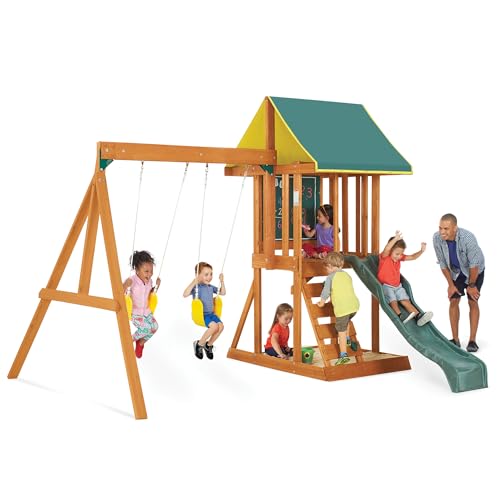
KidKraft Appleton Wooden Swing Set, (Amazon Exclusive) | Rock Wall, Wavy Slide, Vinyl Canopy, 2 Swings, Sandbox Area, For Ages 3+
Check price on Amazon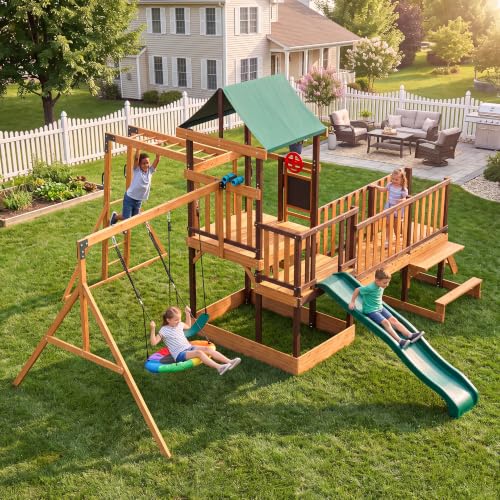
EROMMY Wooden Swing Set for Backyard, 6-in-1 Outdoor Playset with Slide | Wave slide, two swings, monkey bars, climbing wall, elevated walkway, and built-in table & chair inspire backyard adventures
Check price on Amazon
Backyard Discovery Rosewood Falls Cedar Wood Swing Set with Monkey Bars, Clubhouse, Crow's Nest, Play Kitchen, Wave Slide, Rock Wall, Belt Swings, Web Swing, Half Door, Chalkboard, Outdoor Playset
Check price on Amazon
MOCUTEEN 8-in-1 Toddler Climber and Slide Playset with Basketball Hoop - Indoor/Outdoor Playground Gym Activity Center for Kids
Check price on Amazon
Backyard Discovery Canyon Creek Cedar Wood Swing Set with Wave Slide, Clubhouse, Play Kitchen, Picnic Area, Belt Swings, Web Swing, Rock Wall, Balconies, Playhouse, Step Ladder, Outdoor Playset
Check price on Amazon
Backyard Discovery Buckley Hill Cedar Wood Swing Set with Wave Slide, Play Deck, Rock Wall Ladder, Belt Swings, Chalkboard, Canopy Roof, Outdoor Playset
Check price on Amazon
Backyard Discovery Mount Mckinley Cedar Wood Swing Set with Wave Slide, Play Deck, Double Rock Wall, Rope Ladder, Web Swing, Belt Swings, Toy Telescope, Steering Wheel, Sandbox Area, Outdoor Playset
Check price on Amazon
Backyard Discovery Sterling Point Cedar Wood Swing Set with Wave Slide, Raised Clubhouse, Wooden Bridge, Rock Wall, Belt Swings, Web Swing, Trapeze, Balcony, Climbing Wall, Ladder, Outdoor Playset
Check price on AmazonFrequently Asked Questions About Backyard Playground Sets
What age is a backyard playground set suitable for?
Most backyard playground sets are designed for children aged 3 to 12. However, specific features like toddler swings, climbing walls, and slide heights vary by model. Always check the manufacturer's age recommendation and ensure the set matches your child's developmental stage. Younger children need enclosed platforms and bucket swings, while older children benefit from climbing challenges and taller slides.
How much space do I need for a playground set?
A minimum clearance of 6 feet around all sides of the playset is recommended, with 6 feet of clearance in front of and behind swings. For a standard set with a slide and two swings, plan for an area of at least 20 by 20 feet. Always measure your yard and account for fences, trees, and other obstacles before finalizing your choice.
What type of ground surface is best under a playground set?
Safety surfacing is essential. Options include rubber mulch, wood chips, sand, or poured rubber. The surface should extend at least 6 feet beyond the play structure in all directions and be deep enough to cushion falls. Rubber products typically offer the best shock absorption and longevity, while loose-fill materials like wood chips and sand are effective but require periodic replenishment.
How long does it take to assemble a backyard playground set?
Assembly time varies by complexity, typically ranging from 4 to 12 hours. Many sets require two adults. Professional installation is available for some brands and can be worthwhile for larger, more complex structures. Always follow the manufacturer's instructions and use the provided hardware.
Can I add components to a playground set later?
Many mid-tier and high-end playground sets are modular, allowing you to add swings, slides, climbing attachments, or a sandbox as your children grow. Check the manufacturer's add-on compatibility before purchasing. Modular designs make it easier to adapt the set to changing needs without replacing the entire structure.
How do I maintain a wooden playground set?
Inspect the set annually for loose bolts, splinters, and signs of rot. Tighten hardware as needed and reapply sealant or stain every one to two years. Check swing chains, slide connections, and climbing holds monthly for wear. In winter, cover or store removable components and check for frost heave in spring.
Final Thoughts: Building a Backyard That Grows With Your Family
A playground set is more than a purchase—it is an investment in your children's health, creativity, and happiness. By considering your available space, your children's ages and abilities, the materials that suit your climate, and the safety features that protect against injury, you can choose a set that delivers years of active play.
Whether you opt for a compact starter set for a toddler or a flagship-tier play tower for a growing family, the right playground set transforms your backyard into a destination. Use the tier comparisons, safety guidelines, and age-specific recommendations in this guide to make a confident decision. And remember: proper installation, quality surfacing, and regular maintenance are just as important as the set itself.
For more outdoor play inspiration, explore our guides to outdoor play equipment for 4 year olds, playsets, and outdoor toys to complete your backyard adventure zone.