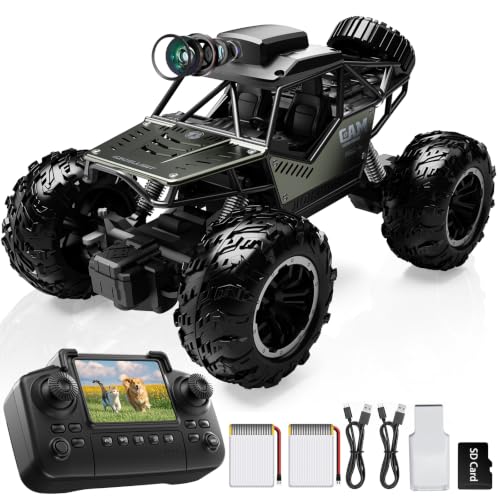
Long Range Remote Control Car with Camera: The Ultimate Buyer's Guide
Everything you need to know before choosing an FPV-ready RC car — range, camera quality, durability, and the features that truly matter.
If you are in the research phase and already know you want a camera-equipped RC vehicle, the real question becomes: which specification actually matters? Range, latency, camera resolution, battery endurance, and build quality all interact. A car that excels in one area may fall short in another. Below, we examine each factor in plain language and explain how to weigh them against your intended use.
What Makes a Remote Control Car "Long Range"?
"Long range" is a relative term. For most consumer-grade RC cars with cameras, a genuine long-range experience means maintaining a stable video feed and control signal well beyond the typical 30–50 meter limit of entry-level models. Mid-range systems often push past 100 meters, while premium and professional-grade platforms can reach several hundred meters in open environments.
The practical takeaway: look for models that specify their control and video transmission distances separately. A car that claims "long range" but only lists a single figure for both control and video is likely to disappoint in real-world use. Also consider the technology behind the range — 2.4 GHz for control is standard, but 5.8 GHz or Wi-Fi-based systems behave differently in terms of interference and line-of-sight requirements.
Camera Quality: More Than Just Resolution
A camera's megapixel count is only part of the story. Frame rate, latency, and dynamic range matter just as much — especially for an FPV driving experience where a half-second delay can ruin the fun. Here is what to prioritize:
🎥 Resolution
720p is the practical minimum for a clear driving view. 1080p is the sweet spot for mid-range and premium models, offering crisp detail without overwhelming the transmission bandwidth.
⚡ Latency
Low latency (under 200 ms) is essential for responsive driving. High latency makes steering feel disconnected and can turn a fun session into a frustrating one.
🔄 Frame Rate
30 fps is acceptable; 60 fps delivers noticeably smoother motion. For fast-paced driving or racing, higher frame rates are a meaningful upgrade.
💡 Low-Light Performance
If you plan to drive at dusk or indoors, a camera with decent low-light sensitivity and built-in LEDs will keep the feed usable when lighting drops.
Build Quality and Durability
An RC car with a camera is an investment, and it will take hits. Look for reinforced chassis construction, shock-absorbing suspension, and protective housings around the camera module. Off-road models should feature sealed electronics and tires suited to the terrain you plan to tackle.
If your driving will mostly happen on gravel, grass, or uneven ground, consider a dedicated off-road platform rather than a street-tuned model. The off-road remote control truck category covers vehicles designed for exactly this kind of abuse. For those who prefer a smaller, more agile setup, a mini drone with camera that follows you offers a different kind of aerial perspective, but for ground-based FPV driving, a rugged RC car remains the better choice.
Understanding Tiers: Entry-Level to Professional-Grade
Rather than thinking in terms of numbers, it helps to classify camera-equipped RC cars by their market positioning. The table below outlines what each tier typically delivers, so you can match your expectations to the right category.
| Tier | Best For | Typical Characteristics |
|---|---|---|
| Entry-Level | First-time FPV drivers, casual backyard play | Basic 720p camera, shorter control range, plastic chassis, simpler suspension |
| Mid-Range | Enthusiasts who want reliable range and clearer video | 1080p camera, extended range, improved suspension, more durable materials, better latency |
| Premium | Serious hobbyists and frequent outdoor drivers | High-resolution camera, long-range dual-band transmission, reinforced chassis, advanced shock absorption, feature-rich controllers |
| Professional-Grade | Competitive racers, demanding terrain, extended sessions | Top-tier camera optics, minimal latency, commercial-grade components, exceptional durability, professional-level range |
When comparing models, keep in mind that a mid-range car with a well-tuned suspension and low-latency video often delivers a more satisfying experience than an entry-level car with a higher-resolution camera but poor responsiveness. Balance is key.
Battery Life and Charging Considerations
Longer range often means longer drives — and that means battery endurance becomes critical. Most camera-equipped RC cars use lithium-polymer (LiPo) batteries, which offer a good energy-to-weight ratio. Look for models with swappable batteries so you can extend sessions without waiting for a recharge.
Also pay attention to the claimed run time versus realistic run time. A model rated for 30 minutes may deliver closer to 20 under aggressive driving with the camera active. Plan accordingly, and consider picking up a spare battery if extended sessions are important to you.
Control System and Ergonomics
The transmitter matters as much as the car. A comfortable, well-laid-out controller with responsive triggers and precise steering makes a tangible difference. Premium models often include adjustable sensitivity, dual-rate steering, and even smartphone mounts for viewing the camera feed.
If you plan to use a smartphone as your display, verify that the companion app is well-reviewed and updated regularly. A great camera paired with a buggy app is a frustrating combination. For a broader look at how camera technology integrates into remote-controlled toys, explore the mini cars for 12-year-olds to drive section, which touches on related platforms and their capabilities.
Terrain and Environment: Matching the Car to Your Play Space
Where you drive determines what you need. Open fields reward long-range capability. Wooded trails demand obstacle clearance and durable suspension. Backyards with mixed surfaces call for versatility. Before committing, think honestly about your primary driving environment.
For families with younger drivers, a mini car for 10-year-olds to drive may be a more appropriate starting point, while older enthusiasts will appreciate the extra capability and range of a dedicated hobby-grade model. If your interest leans toward collecting and display alongside driving, the model car kits for adults section offers a different but complementary angle.
Safety and Responsible Use
Camera-equipped RC cars are fun, but they deserve the same respect as any radio-controlled vehicle. Keep line of sight where possible, avoid driving near roads or crowded areas, and respect local regulations regarding RC use in public spaces. For younger drivers, adult supervision is strongly recommended, especially when the vehicle is capable of higher speeds.
Also consider privacy: a camera-equipped car should never be used to record people without consent. Treat the camera as you would any other recording device.
Frequently Asked Questions
How far can a long range RC car with camera actually go?
Real-world range depends on terrain, interference, and line of sight. Entry-level models often manage around 50–80 meters, mid-range systems comfortably exceed 100 meters, and premium or professional-grade platforms can reach several hundred meters in open conditions. Always check the manufacturer's stated control and video transmission distances separately.
Is 720p good enough for an FPV RC car?
Yes, 720p is sufficient for a clear, usable driving view, especially if latency is low. However, if you plan to record footage or drive in complex environments where detail matters, 1080p is a worthwhile step up.
Can I use my smartphone as the display?
Many modern camera-equipped RC cars support smartphone mounting via a companion app. Check that the app is compatible with your device and has a reputation for stability before relying on it as your primary display.
What is the difference between control range and video range?
Control range refers to how far the transmitter can send commands to the car. Video range refers to how far the camera feed can travel back to your display. These are often different, and video range is typically the more limiting factor.
Are camera-equipped RC cars suitable for beginners?
Absolutely. Many entry-level and mid-range models are designed with beginners in mind, offering stable handling and straightforward controls. Just start in open, unobstructed spaces and practice before venturing into more complex environments.
Ready to Explore Your Options?
Browse our curated selection of camera-equipped remote control cars and find the model that matches your driving style and terrain.
View Recommended Models