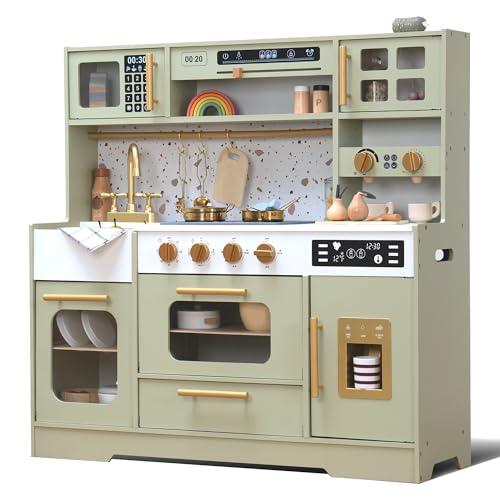
Childrens Wooden Play Kitchen: The Complete Guide
Everything you need to know before choosing a wooden play kitchen for your child — from durability and safety to design and developmental benefits.
🍳 Why a Wooden Play Kitchen? A childrens wooden play kitchen is more than a toy — it is a gateway to imaginative role-play, language development, and fine motor practice. Unlike plastic alternatives, wood offers a natural feel, timeless appeal, and a solid build that can be passed down. Whether you are upgrading from a compact countertop model or furnishing a full playroom, this guide will help you choose with confidence.
Why Pretend Play Kitchens Matter for Development
Before diving into specifications, it helps to understand the developmental value behind the toy. A well-chosen play kitchen supports several key areas of early childhood growth:
🧠 Cognitive Skills
Pretend cooking sequences — chopping, stirring, serving — build sequencing and problem-solving abilities. Children practice cause-and-effect reasoning as they interact with knobs, doors, and drawers.
💬 Language & Social Play
Role-playing as a chef or customer naturally expands vocabulary. Cooperative play with siblings or friends teaches turn-taking, negotiation, and storytelling.
✋ Fine Motor Control
Grasping play utensils, turning knobs, and opening cabinets refine hand-eye coordination and dexterity — skills that transfer to real-world tasks.
🌟 Emotional Growth
Imaginative play gives children a safe space to express emotions, practice independence, and build confidence through self-directed scenarios.
Understanding Play Kitchen Tiers
Wooden play kitchens vary widely in construction, features, and craftsmanship. To help you navigate the market, we classify them into three universal tiers. This system focuses on build quality and feature set rather than any numeric indicator.
| Tier | Best For | Typical Construction | Feature Set |
|---|---|---|---|
| Entry-Level | First-time buyers, small play areas | Medium-density wood composite with painted finish; basic assembly | Compact footprint, essential appliances (stove, sink, oven), few accessories |
| Mid-Range | Growing families, daily play | Solid wood frame with reinforced joints; non-toxic water-based finish | Multiple cooking zones, refrigerator, storage shelves, some interactive elements |
| Premium | Long-term use, design-conscious homes | Hardwood construction (birch, beech, or rubberwood); smooth sanded edges; heirloom-quality joinery | Full appliance suite, realistic details, ample storage, accessories included |
💡 Buyer's Tip: The mid-range tier usually offers the best balance of durability and feature richness for most families. Entry-level models work well for temporary setups or smaller spaces, while premium kitchens are a long-term investment that can be repainted and refreshed as tastes change.
What to Look For in a Childrens Wooden Play Kitchen
A careful evaluation of materials, safety features, and layout will save you from disappointment later. Use this checklist as your buying compass:
- Solid wood vs. composite: Solid hardwood (birch, beech, rubberwood) resists wear better than particleboard or MDF. Look for reinforced joints and doweled construction on mid-range and premium models.
- Non-toxic finishes: Choose water-based paints and finishes that are certified low-VOC. This matters because young children frequently touch and mouth surfaces.
- Rounded edges and smooth sanding: Every exposed edge should be rounded or chamfered. Run your hand along surfaces — there should be no splinters or rough patches.
- Stability and anti-tip design: A play kitchen should sit flat and resist tipping. Look for wide bases, wall-anchoring hardware, and a low center of gravity.
- Age-appropriate height: The counter should sit at roughly waist height for your child. Adjustable feet or leg extensions help the kitchen grow with your child.
- Storage and organization: Shelves, hooks, and cubbies keep accessories tidy and encourage children to tidy up independently. Check for smart storage ideas that complement your playroom.
- Realistic but safe details: Turning knobs, clicking oven doors, and faux faucets add engagement without creating choking hazards. Avoid small detachable parts for children under three.
- Ease of assembly: Pre-drilled holes, clear instructions, and labeled hardware make home assembly manageable. Some premium brands offer white-glove delivery.
Safety Standards You Should Verify
Reputable manufacturers comply with regional toy safety regulations. Before purchasing, confirm that the product carries the relevant certification for your market:
🌎 ASTM F963
The U.S. consumer safety specification for toy safety, covering mechanical hazards, flammability, and heavy metals in surface coatings.
🇪🇺 EN71
The European toy safety standard, with specific parts addressing mechanical and physical properties, migration of certain elements, and chemical safety.
🛡 CPSC Compliance
In the United States, toys must comply with Consumer Product Safety Commission rules, including tracking labels and third-party testing for children's products.
⚠️ Safety Note: Always follow the manufacturer's age recommendation and assembly instructions. Anchor tall units to the wall if hardware is provided. Supervise young children during play, especially around hinged doors and small accessories. For more guidance, explore our broader toy safety guide.
Planning Your Play Space
Wooden play kitchens come in several configurations. Measuring your available space before you shop prevents the frustration of a poor fit.
| Configuration | Typical Footprint | Best Placement |
|---|---|---|
| Corner / Compact | Approximately 3 ft × 3 ft | Playroom corner, bedroom nook |
| Single-Wall | Approximately 4 ft × 2 ft | Along a playroom wall, beside shelving |
| L-Shaped / U-Shaped | Approximately 5 ft × 4 ft | Dedicated play area, shared family space |
When laying out the room, leave at least two feet of clearance in front of the kitchen for children to move freely. Consider placing the kitchen near a play tent or reading corner to create a cohesive play zone. If you are still organizing the room, our playroom organization guide offers practical layout ideas.
Common Woods Used in Play Kitchens
The type of wood affects weight, durability, and appearance. Here is a quick reference for the most common materials:
| Wood Type | Characteristics | Tier Typically Used |
|---|---|---|
| MDF / Particleboard | Uniform surface, painted finish, lighter weight | Entry-level |
| Pine | Soft wood, easy to dent, takes paint well | Entry-level to mid-range |
| Rubberwood | Dense and durable, smooth grain, excellent for painted finishes | Mid-range |
| Birch / Beech | Hard, tight grain, holds details well, premium feel | Mid-range to premium |
Accessories That Extend the Play Value
Most wooden play kitchens come with a starter set of accessories. Adding a few thoughtful pieces can deepen the pretend-play experience:
- Wooden play food sets: Slices of fruit, vegetables, and bread encourage cutting and serving scenarios.
- Cookware and utensils: Pots, pans, and spatulas sized for little hands reinforce fine motor practice.
- Aprons and chef hats: Simple fabric accessories help children step into the role of chef.
- Storage bins: Small baskets or bins keep accessories organized; see our storage bin guide for family-friendly options.
- Play clocks and timers: Add early time-telling practice to cooking scenarios.
Frequently Asked Questions
What age is a childrens wooden play kitchen suitable for?
Most models are designed for ages 3 and up, though some simpler designs suit toddlers from age 2 with adult supervision. Always check the manufacturer's age recommendation and safety labels before purchasing.
What are the benefits of wood over plastic?
Wooden play kitchens offer superior durability, a natural tactile experience, and a timeless aesthetic. They tend to be more stable, can often be repainted or repaired, and hold their appeal across multiple children.
How much space does a wooden play kitchen need?
A typical corner model needs roughly a 3-foot by 3-foot footprint, while larger L-shaped or U-shaped configurations may require a wider wall area. Measure your available space and allow at least two feet of clearance in front.
Are wooden play kitchens safe for young children?
Yes, when they meet recognized safety standards. Look for rounded edges, non-toxic finishes, stable construction, and certifications such as ASTM F963 or EN71. Avoid models with small detachable parts for children under three.
Can a wooden play kitchen be repainted?
Most painted wooden kitchens can be lightly sanded and repainted with child-safe, water-based paint. Check the manufacturer's guidance first, and always use non-toxic finishes.
Exploring a broader range of playroom furniture? Pair your play kitchen with a children's play house or browse our building toys collection for construction-themed play. If you are planning a birthday or holiday surprise, our gift guides offer curated recommendations by age and occasion.