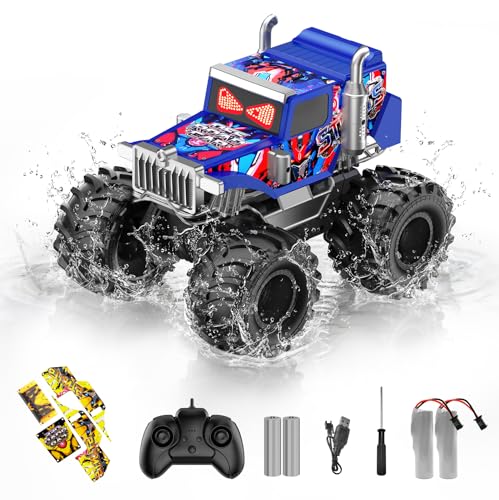
Remote Control Monster Truck That Goes in Water: The Ultimate Amphibious RC Guide
Everything you need to know about amphibious RC monster trucks — how they work, what to look for, and how to pick the right one for backyard puddles, poolside fun, or lakeside adventures.
You have probably seen the videos: a rugged RC monster truck charges straight into a pond, keeps driving across the surface, and climbs out on the other side. It looks like magic, but it is really smart engineering. A remote control monster truck that goes in water combines waterproof electronics, sealed drivetrain components, and buoyant chassis design to handle wet environments that would destroy a standard RC truck.
This guide breaks down exactly how amphibious RC trucks work, the features that matter most, the different categories available, and practical tips for getting the most out of your purchase. By the end, you will have a clear understanding of what separates a true water-capable monster truck from a model that merely claims "water resistance."
How Does an RC Monster Truck Drive on Water?
An amphibious RC monster truck does not actually drive under water like a submarine. Instead, it uses one of two main approaches to travel across the surface:
- Buoyancy-based design: The chassis and oversized tires are engineered to float. The truck sits on top of the water, and the spinning tires act like paddle wheels to propel it forward. This is the most common approach for consumer-grade amphibious RC trucks.
- Hydroplaning design: Some models use wide, flat tires and a lightweight body that allow the truck to skim across the water surface at speed, similar to how a skipping stone works. These models typically require more momentum to stay on top.
In both cases, the critical enablers are waterproof electronics (receiver, speed controller, and servo), sealed battery compartments, and rust-resistant hardware. Without these, water would quickly short the electronics or corrode the drivetrain.
Key insight: A truck labeled "water-resistant" can handle splashes and damp grass. A truck labeled "waterproof" or "amphibious" is designed for full water contact. These are not the same thing — and the distinction matters enormously if you plan to drive in a pond or pool.
Critical Features to Evaluate Before Buying
Not all amphibious RC trucks are built to the same standard. Here are the features that separate a capable water monster truck from a disappointing one:
IP Rating & Sealing
Look for an explicit IP rating (IPX7 or IPX8 is ideal). Sealed battery trays, rubber-gasketed compartments, and waterproof connector plugs are non-negotiable for genuine water use.
Tire Design
Paddle-style or deeply grooved tires with soft, high-traction rubber provide grip on wet surfaces and act as propulsion on water. Foam-filled tires prevent waterlogging.
Chassis Buoyancy
A lightweight yet buoyant chassis keeps the truck afloat. Hollow body panels and sealed undercarriage trays are common design solutions.
Motor & Drivetrain Protection
Brushless motors with sealed bearings and corrosion-resistant gears last far longer in wet conditions than exposed brushed setups. Stainless steel screws and shafts resist rust.
Battery Safety
Waterproof LiPo battery packs with sealed connectors are essential. Never use a standard open-contact battery pack in a water-capable truck.
Range & Control
2.4GHz radio systems with at least 100 feet of range give you confidence near water. Some premium models offer signal-fail-safe that stops the truck if connection drops.
Types of Water-Capable RC Monster Trucks
The market for amphibious RC trucks breaks down into three broad tiers. Understanding these helps you match a truck to your intended use without over- or under-buying.
| Tier | Typical Characteristics | Best For |
|---|---|---|
| Entry-level | Basic splash resistance, moderate buoyancy, brushed motor, shorter runtime. Good for puddles, wet grass, and shallow water. | First-time RC buyers, younger drivers, casual backyard play. |
| Mid-range | True amphibious capability, sealed electronics, paddle tires, brushless motor options, longer runtime, better build quality. | Regular water play, poolside fun, families wanting a durable all-terrain truck. |
| Top-tier / professional-grade | Full IPX8 sealing, high-torque brushless systems, metal drivetrain components, advanced suspension, long range, premium materials. | Serious hobbyists, lake and stream exploration, users who want maximum durability and performance. |
If you are exploring the broader category of rugged off-road RC vehicles, you may also want to compare a standard remote control monster truck or a remote control monster truck for outside use. Many of the same durability principles apply, even if those models are not designed for water.
Water vs. Land Performance: What to Expect
A common question is whether an amphibious truck sacrifices land performance for water capability. The short answer: modern designs have narrowed the gap significantly, but there are still trade-offs.
- On land: Amphibious trucks tend to be slightly heavier due to sealing and buoyancy features, which can affect acceleration and jump height. However, mid-range and top-tier models compensate with stronger motors and better suspension.
- On water: Speed on water is typically lower than on land — often 30–50% slower — because the tires are acting as paddles rather than gripping a solid surface. Steering response is also softer on water.
- Transition zones: The best amphibious trucks handle the land-to-water transition smoothly. Cheaper models may struggle to climb out of water onto a bank, especially if the edge is steep or slippery.
Practical tip: If your primary use is water play, prioritize buoyancy and sealing over raw speed. If you split time between land and water, look for a model with a strong brushless motor and adjustable suspension to balance both environments.
Safety and Maintenance for Amphibious RC Trucks
Water introduces new maintenance requirements. Following these practices will dramatically extend the life of your truck:
- Rinse after every water session. Fresh water rinsing removes salt, chlorine, and debris. Pay special attention to the drivetrain and wheel hubs.
- Dry thoroughly before storage. Remove the battery, open sealed compartments if the manufacturer allows, and let everything air-dry completely. Never store a wet truck in a closed bag or box.
- Lubricate moving parts. Use waterproof silicone grease on driveshafts, bearings, and suspension pivot points after drying.
- Inspect seals regularly. Rubber gaskets degrade over time. Check them monthly and replace any that show cracking or stiffness.
- Never charge a wet battery. Ensure the battery and connectors are completely dry before charging.
- Check the manual for depth limits. Even amphibious trucks have maximum recommended water depths. Exceeding them can flood the electronics.
How to Choose the Right Amphibious RC Truck
Use this decision framework to narrow your options:
- Where will you drive it? A backyard puddle needs less capability than a lake. Match the truck's water rating to your actual environment.
- Who is driving? Younger children benefit from slower, simpler entry-level models with easy controls. Adults and teens can handle higher-performance mid-range or top-tier trucks.
- How often will you use it? Occasional use can justify an entry-level model. Frequent water play warrants a mid-range or premium build with better sealing and corrosion resistance.
- What is the parts situation? Choose a brand with readily available replacement batteries, tires, and seals. A truck you cannot maintain is a truck that will not last.
- Check reviews for real-world water performance. Look specifically for feedback on buoyancy, sealing longevity, and how the truck handles the land-to-water transition.
If you want to explore other categories of remote control vehicles for comparison, browse our full collection of remote control toys. You might also find our guide to the remote control truck category useful for understanding the broader landscape of RC trucks.
Frequently Asked Questions
Can any RC monster truck go in water?
No. Standard RC trucks are not designed for water contact. Only models explicitly labeled waterproof or amphibious have the sealed electronics and buoyancy features required for safe water use. Driving a non-waterproof truck in water will likely cause permanent damage.
Do amphibious RC trucks float?
Most true amphibious models are designed to float on the water surface. The chassis and tires provide buoyancy, while the spinning tires propel the truck forward. However, buoyancy varies by model — always check the manufacturer's specifications.
How fast can a water RC monster truck go?
Water speed is typically lower than land speed. Entry-level models may move at a walking pace on water, while mid-range and top-tier models can achieve a brisk jogging speed. Water drag and paddle-tire efficiency are the limiting factors.
Can I use my amphibious RC truck in saltwater?
Saltwater is more corrosive than freshwater. If you use your truck in saltwater, rinse it thoroughly with fresh water immediately afterward and lubricate all moving parts. Some manufacturers explicitly advise against saltwater use — check your manual first.
How deep can an amphibious RC truck go?
Depth limits vary by model. Most consumer amphibious trucks are designed to stay on the water surface and are not intended to submerge. For shallow-water driving (a few inches), many waterproof models are fine. Always follow the manufacturer's stated depth limit.
Ready to explore amphibious RC monster trucks? Browse our curated selection of water-capable remote control trucks below and find the right match for your adventures.