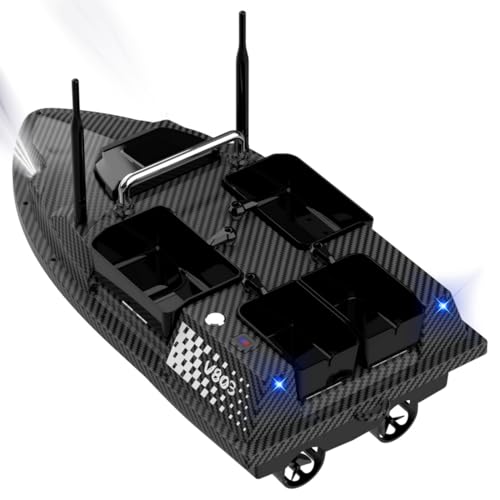
Remote Control Fishing Boat with Baitcasting: The Ultimate Angler's Guide
Cast farther, fish smarter, and reach spots you never thought possible. Whether you're a shoreline angler or a serious carp hunter, an RC bait boat with baitcasting capability transforms how you present your rig. This expert guide covers everything you need to know before choosing your model.
Explore the Buying GuideWhy an RC bait boat? A remote control fishing boat with baitcasting lets you deliver baited rigs, hooks, and lines to precise locations far beyond casting range. Instead of relying on brute casting strength or a lucky drift, you control the drop zone with meter-level accuracy. For anglers targeting carp, catfish, or pike in large lakes and rivers, these boats are a genuine game-changer — saving time, reducing snags, and putting your bait exactly where the fish are holding.
What Exactly Is a Remote Control Fishing Boat with Baitcasting?
A remote control fishing boat with baitcasting combines two core functions: remote navigation and precision bait delivery. The boat is driven by a handheld transmitter, typically operating on 2.4 GHz for interference-free control. The baitcasting element refers to the boat's ability to carry and release a rig — often a hook, bait, or a baited line — at a chosen location. Some advanced models include a dedicated bait hopper that opens remotely, while others use a release clip that drops the rig when you trigger it from shore.
The term "baitcasting" here differs slightly from the rod-and-reel baitcasting technique. In the context of RC fishing boats, it refers to the boat's built-in mechanism for casting or releasing bait at distance. This is why these boats are sometimes called "bait boats" or "bait delivery boats." They're particularly popular in Europe and Asia for carp fishing, and increasingly in North America for catfish and bass.
Unlike a standard remote control boat for adults, which is built for speed and sport, a fishing bait boat prioritizes stability, payload capacity, and slow-speed precision. The hull is typically wider and deeper, with a high-torque motor that can handle the weight of bait, rigs, and electronics without losing control.
How Does Baitcasting Work on an RC Fishing Boat?
The mechanism varies by model, but the principle is consistent: you load the bait or rig into a compartment or clip, navigate the boat to your target spot, and then trigger the release. Here's a breakdown of the common systems:
- Remote-release hopper: The most common design. A small trapdoor or hatch opens via a servo signal from your transmitter, dropping the baited rig directly below the boat. This is ideal for dropping a hook with a float or a lead weight.
- Line-release clip: Your fishing line is clipped to a release mechanism on the boat. When you trigger the release, the line detaches and the boat can return while your rig stays in place. This is often used with a separate rod and reel on shore.
- Combined bait and line delivery: Some high-end models let you carry both a baited rig and a hooked line, releasing them independently. This gives you the flexibility to pre-bait a spot and then cast your hook.
Most bait boats include a GPS return-to-home function or a compass-assisted return, which brings the boat back to the launch point automatically. This is especially useful in low-light conditions or when the boat drifts out of visual range. If you're new to RC boating, it's worth reading up on general RC boat handling tips before your first bait run.
Key Features to Look For
Payload Capacity
The boat must carry your bait, rig, and sometimes a lead weight without sitting too low in the water. Entry-level models handle lighter rigs, while mid-range and premium models support heavier payloads with dual hoppers.
Control Range
2.4 GHz systems typically offer a range of 150–500 meters, depending on the model. If you fish large lakes, prioritize a boat with a longer control range and a clear signal indicator on the transmitter.
Battery Life & Runtime
Look for a boat with a runtime of at least 30–45 minutes per charge. Premium models often include swappable battery packs, so you can carry a spare and extend your session without heading back to shore.
GPS & Return-to-Home
A GPS-assisted return function is a major safety feature. If the signal drops or the battery runs low, the boat can navigate back to its launch point automatically, preventing a lost vessel.
Waterproofing & Build Quality
Fishing environments are wet and unpredictable. Choose a boat with a reinforced hull, sealed electronics compartment, and rust-proof hardware. A well-built RC boat should handle choppy water and occasional splashes.
Bait Release Mechanism
The release system should be reliable and easy to reload. Servo-driven hoppers are more precise than mechanical clips, but both work well when maintained properly. Test the release before each session.
Tier Comparison: Which Class Fits Your Fishing Style?
Rather than focusing on arbitrary numbers, it helps to understand where a boat sits in the market. The table below uses universal tier descriptors to compare the three main classes of RC bait boats. These descriptors reflect relative positioning, not absolute figures.
| Tier | Best For | Typical Features | Control Range |
|---|---|---|---|
| Entry-level / Starter tier | Occasional anglers, small ponds, lightweight rigs | Single bait hopper, basic 2.4 GHz transmitter, manual return, shorter runtime | Up to ~150 meters |
| Mid-range / Balanced tier | Regular anglers, medium lakes, mixed rig weights | Dual hoppers or combined bait/line release, GPS-assisted return, swappable battery, reinforced hull | ~150–300 meters |
| Premium / Top-tier | Serious carp and catfish hunters, large waters, long sessions | GPS autopilot with waypoints, dual independent release, high-capacity battery, heavy-duty motors, telemetry display | 300+ meters |
A mid-range model often strikes the best balance for most anglers. It offers the reliability and range you need without the complexity of a professional-grade system. If you're fishing from a fixed bank spot and want dependable bait delivery, the balanced tier is usually the sweet spot. For those who fish competitively or in very large waters, the top-tier models provide the extra range, payload, and automation that make long sessions more productive.
Buying Guide: How to Choose the Right Bait Boat
1. Match the Boat to Your Water
Small ponds and narrow rivers don't demand a long-range boat. A starter-tier model with a 100–150 meter range is perfectly adequate. But if you fish large reservoirs, gravel pits, or wide rivers, invest in a mid-range or premium boat with a longer control range and GPS return. The last thing you want is to lose signal with a loaded rig halfway across the lake.
2. Consider Your Bait and Rig Weight
Heavy lead weights, large bait presentations, and multiple hooks add weight. Check the boat's payload rating — it's usually listed in the specifications. A boat that sits too low in the water is harder to control and more prone to taking on water. If you regularly use heavy rigs, choose a model with a deeper hull and higher payload capacity.
3. Release Mechanism Reliability
The bait release is the heart of the boat. A sticky or unreliable release can cost you a fish. Look for servo-driven hoppers with a smooth action, and read user reviews about long-term reliability. Some anglers prefer a simple line-release clip because there's less to go wrong, while others value the precision of a remote hopper. There's no single right answer — it depends on your fishing style.
4. Battery and Runtime
A typical session might involve multiple bait drops, so runtime matters. Entry-level boats often run 20–30 minutes per charge, while mid-range and premium models can exceed 45 minutes. Swappable batteries are a huge convenience — you can carry a spare and keep fishing without waiting for a recharge. Also, check the charging time; some boats take several hours to fully charge.
5. Portability and Storage
If you hike to your fishing spot, a lighter boat is easier to carry. Premium models with large batteries and reinforced hulls are heavier, so consider how you'll transport the boat. A carry bag or backpack-style case is a nice bonus. Also, think about storage — the boat should fit in your vehicle without requiring a trailer.
6. Weather and Water Conditions
Wind and chop can challenge even experienced RC pilots. A boat with a wider beam and higher freeboard handles rough water better. If you frequently fish in windy conditions, prioritize stability over speed. A durable RC boat with a well-designed hull will track straighter and resist capsizing.
Setup Tips and Field Techniques
Getting the most from your bait boat is about more than just steering. Here are practical tips that experienced anglers swear by:
- Calibrate the compass before every session. Many GPS-equipped boats require a compass calibration at the launch point. This ensures the return-to-home function works accurately.
- Test the bait release on land. Before you load a rig, trigger the release mechanism to confirm it operates smoothly. A dry test saves you from a failed drop on the water.
- Use a marker float. When you drop bait, note the location with a marker float or a visual reference on shore. This helps you cast to the same spot later.
- Keep the boat within visual range. Even with GPS, it's wise to maintain line of sight. If the boat drifts behind an obstacle, you may lose signal temporarily.
- Rinse and dry after every use. Freshwater is less corrosive than saltwater, but consistent maintenance extends the life of the motors, servos, and hull. A well-maintained RC boat will serve you for many seasons.
- Practice in open water first. Before you attempt precise bait drops near snags or lily pads, spend time learning the boat's handling characteristics in open water.
Frequently Asked Questions
Can I use a bait boat in saltwater?
How far can an RC bait boat go?
What happens if the battery dies while the boat is on the water?
Can I attach my own fishing rod and reel to the boat?
Are bait boats legal everywhere?
How do I maintain the bait release mechanism?
Ready to Put More Bait on Target?
An RC fishing boat with baitcasting capability is a long-term investment in your fishing success. Whether you choose a starter-tier model for casual sessions or a top-tier system for serious campaigns, the right boat will change how you approach the water. Use the buying guide above to narrow your options, and always prioritize reliability, range, and a dependable release mechanism.
View Recommended Models